
A Pyrofuse (or pyro fuse) is an actively triggered, one-time disconnect that cuts a high-current busbar on command. A conventional fuse is a passive overcurrent device: its calibrated element heats and melts only when current exceeds its time-current limit. That is the essential Pyrofuse meaning and the reason EV battery systems often use both devices rather than treating them as substitutes.
I. Fuse vs Pyrofuse: Quick Answer
Quick answer: Choose a conventional fuse for independent overload and short-circuit protection. Use a Pyrofuse when the battery must disconnect after a crash, insulation fault, thermal event or controller-detected hazard, including events that may not produce enough current to melt a normal fuse.
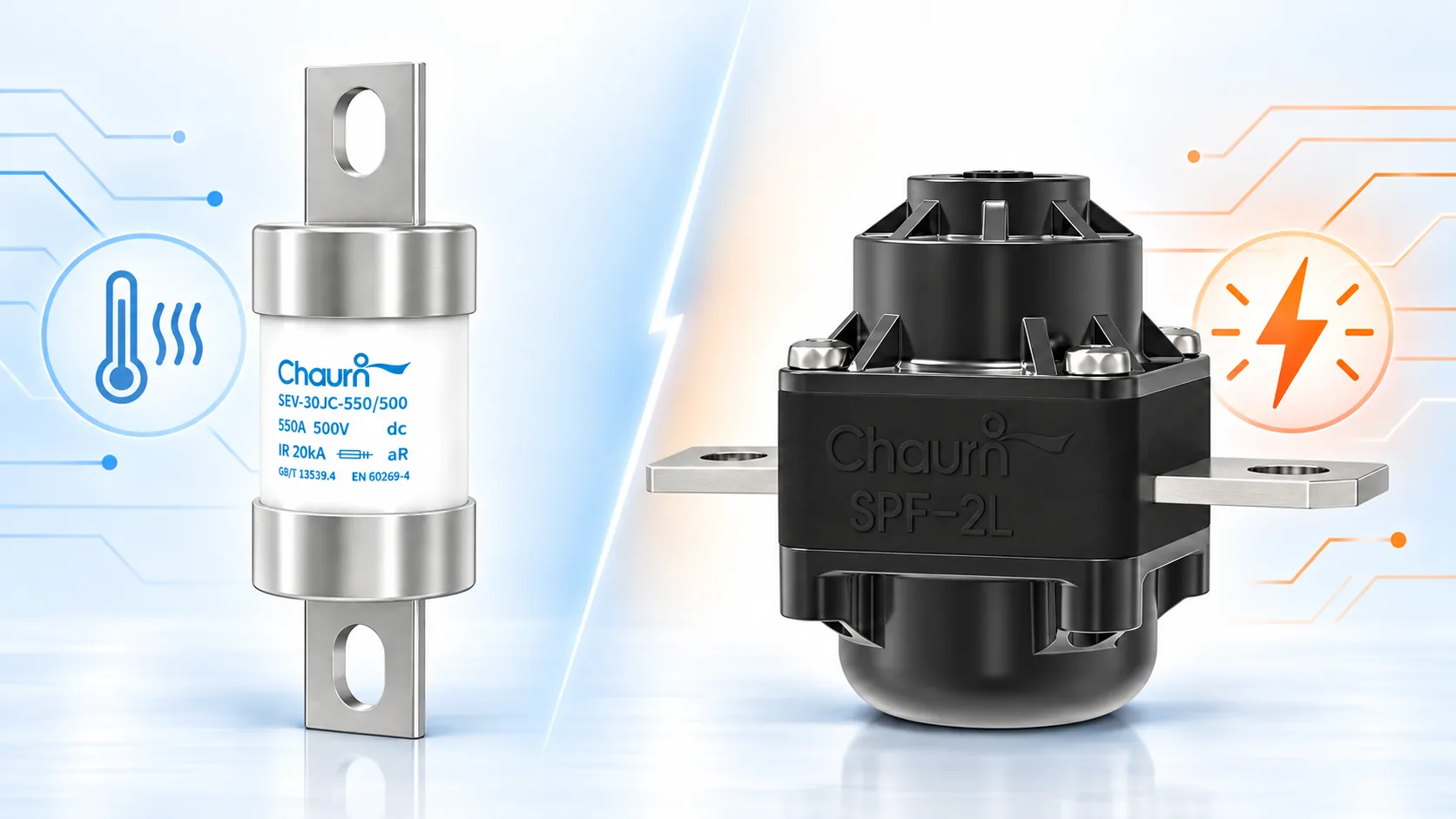
The main difference between a fuse and a Pyrofuse is how each device is activated. A conventional electrical fuse is a passive circuit protection device. When excessive current passes through its fusible element, electrical resistance generates heat. The element eventually melts, opening the circuit.
A Pyrofuse, also called a pyro fuse, pyrotechnic fuse, or pyro safety switch, is generally an active protection device. It receives a trigger signal from a battery management system, electronic control unit, or airbag controller. A small pyrotechnic charge then drives a piston or cutter through a busbar, interrupting the current path.
In simple terms:
- A conventional fuse reacts to current
- A Pyrofuse reacts to an electronic command
- A fuse protects mainly against overcurrent and short circuits
- A Pyrofuse provides rapid emergency battery isolation
These devices are not always direct substitutes. Many EV architectures use both because they perform complementary safety functions.
II. What Is a Conventional Fuse?
A conventional fuse is a one-time electrical protection device designed to interrupt a circuit when current exceeds a specified level for a certain period. Its central component is a calibrated fusible element, usually made from a metal or alloy with predictable thermal properties.
During normal operation, current flows through the element with minimal resistance. During an overcurrent event or short circuit, increased current produces heat according to the electrical relationship P = I²R. Once the element reaches its melting point, it separates and stops current flow.
Common fuse types include:
- Automotive blade fuses
- Cartridge fuses
- High-voltage EV fuses
- Fast-acting fuses
- Time-delay fuses
- Semiconductor fuses
A fuse’s performance is defined by its rated current, voltage rating, interrupting rating, I²t value, and time-current curve. Because its response depends on fault-current magnitude, a small overload may take longer to clear than a severe short circuit. Once the fuse operates, it must be replaced.
III. What Is a Pyrofuse?
A Pyrofuse is an irreversible battery disconnect device that uses a controlled pyrotechnic reaction to physically open a high-current circuit. It is commonly installed in electric vehicles, hybrid vehicles, high-voltage battery packs, and battery disconnect units.
A typical Pyrofuse contains:
- An electrical initiator
- A small pyrotechnic charge
- A gas-generating element
- A piston or cutting mechanism
- A conductive busbar
- An insulated arc-control structure
When a dangerous condition is detected, the vehicle’s BMS, ECU, or airbag control unit sends an ignition current to the initiator. The pyrotechnic material produces gas pressure, moving a piston that cuts or separates the busbar. This creates a permanent gap in the current path.
Unlike a conventional fuse, a Pyrofuse does not need to wait for current-generated heat to melt a conductor. It can disconnect the battery following a collision, insulation fault, thermal warning, or other electronically detected hazard—even when the current has not exceeded a normal fuse rating.
IV. The Main Difference Between a Fuse and a Pyrofuse
The fundamental distinction is passive thermal operation versus active pyrotechnic operation. A fuse monitors nothing electronically. It responds naturally when current flowing through its element produces sufficient heat. A Pyrofuse depends primarily on a trigger command generated by sensors and control electronics.
| Key difference | Conventional fuse | Pyrofuse |
|---|---|---|
| Activation | Excessive current | Electronic trigger signal |
| Operating method | Melts a fuse element | Cuts or separates a busbar |
| Protection type | Passive | Usually active |
| Main purpose | Overcurrent protection | Emergency circuit isolation |
| Crash response | Not inherently available | Can be crash-activated |
| Control unit | Not required | Usually required |
This difference matters because not every dangerous situation produces immediate overcurrent. After a collision, for example, a damaged high-voltage cable may present an electric-shock or fire risk without drawing enough current to blow a conventional fuse. A properly integrated pyrotechnic battery disconnect can isolate the battery as soon as the crash control system identifies the event.
V. Chauron HVDC Fuse and SPF-2L Pyrofuse Examples
The distinction is easier to see in real products. Chauron’s conventional HVDC fuses and SPF-series Pyrofuses are engineered for different protection jobs, even when both sit in a high-voltage battery circuit.
| Chauron example | Protection role | Key engineering checks |
|---|---|---|
| Chauron HVDC Fuse | Passive overload and short-circuit interruption | DC voltage, continuous current, time-current curve, breaking capacity and total-clearing I²t |
| Chauron SPF-2L Pyrofuse | Commanded emergency isolation for EV, charging, ESS and high-current DC systems | Up to 930 VDC, trigger current and duration, circuit inductance, breaking duty, diagnostics and BDU integration |
For example, SPF-2L is specified for externally triggered interruption, with a rated platform up to 930 VDC and sub-millisecond operation under stated trigger conditions. Those figures do not make it a drop-in replacement for every fuse. Engineers must validate the complete protection chain, including the BMS or ECU trigger, contactors, cable inductance and prospective fault current. See the 400 V and 800 V Pyrofuse selection guide for system-level checks.
VI. How Their Triggering Methods Differ

A conventional fuse uses current-dependent triggering . It operates when the temperature of its fusible element reaches a critical point. The operating time is affected by fault current, fuse construction, ambient temperature, cooling conditions, and previous thermal loading. A moderate overload may take seconds or minutes to clear, while a severe short circuit can open the fuse much faster.
A Pyrofuse uses signal-controlled triggering. Possible trigger sources include:
- Crash or impact sensors
- Battery management systems
- Airbag control units
- Current and voltage sensors
- Insulation monitoring devices
- Thermal runaway detection systems
The controller evaluates sensor data and sends a defined firing pulse to the trigger circuit or squib driver. Some modern designs offer dual activation: they can receive an external BMS command and also react independently to an extreme electrical fault.
This active approach allows the protection strategy to consider more than current alone. Nevertheless, the sensors, power supply, software, wiring, and trigger driver must all be included in the functional-safety assessment.
VII. Response Time and Fault-Interruption Performance
Conventional fuse response is described through a time-current characteristic rather than a single fixed operating time. The larger the overcurrent, the faster the fuse element heats and melts. Engineers must evaluate pre-arcing time, total clearing time, peak let-through current, I²t rating, and breaking capacity.
A Pyrofuse provides a more controlled mechanical response after receiving a valid activation command. Because it does not have to wait for thermal melting, it can produce millisecond-scale disconnection. However, the complete system response also includes:
- Fault detection time
- Controller decision time
- Trigger-signal transmission
- Initiator activation
- Busbar separation
- Arc extinction
Therefore, “faster” should not be treated as an absolute claim for every operating condition. A high-speed conventional fuse may clear an extreme short circuit quickly, while a poorly designed electronic detection system could delay a Pyrofuse command.
The appropriate comparison should consider the complete protection chain, not just the actuator. Voltage, current direction, inductance, fault energy, and arc management all influence interruption performance.
VIII. Why Pyrofuses Are Used in Electric Vehicles
Modern EV battery packs store substantial energy and operate at 400 V, 800 V, or higher internal voltage levels. Following a collision, damaged cables or power electronics can expose occupants and emergency responders to electric shock, arcing, fire, or unexpected vehicle movement. For application context, review Chauron’s EV fuse and Pyrofuse solutions.
A Pyrofuse allows the vehicle to disconnect the high-voltage battery when the safety controller identifies a critical event. Typical activation conditions may include:
- Severe vehicle collision
- Battery-pack deformation
- Insulation failure
- Abnormal current
- Thermal runaway warning
- Charging-system fault
Because the conductive busbar can be designed with low resistance, a Pyrofuse may also reduce normal-operation heat generation and power loss in high-current systems.
The device is commonly located inside a battery disconnect unit, high-voltage junction box, or battery pack. It works alongside contactors, conventional EV fuses, current sensors, and the BMS. This coordinated protection architecture allows normal switching, passive short-circuit protection, and irreversible emergency isolation to be handled by devices optimized for each function.
IX. Can a Pyrofuse Replace a Conventional Fuse?
A Pyrofuse cannot automatically replace a conventional fuse because their primary protection functions are different. A conventional fuse provides independent overcurrent and short-circuit protection without needing sensors, software, or an external power supply. An active Pyrofuse requires a functioning detection and firing system.
Conversely, a normal fuse may not replace a Pyrofuse in a crash-isolation application. A collision can create a dangerous electrical condition without producing enough current to melt the fuse element. In that situation, electronically controlled disconnection is necessary.
Many high-voltage systems therefore use:
- A conventional fuse for passive fault-current protection
- Main contactors for regular connection and disconnection
- A Pyrofuse for irreversible emergency isolation
- A BMS and current sensors for fault detection
Some manufacturers offer hybrid Pyrofuse designs that integrate a fuse element and pyrotechnic disconnector. These can provide overcurrent protection and active triggering in one assembly. Even then, compatibility must be verified through voltage, current, I²t, breaking-capacity, environmental, and functional-safety specifications.
X. Advantages and Limitations
Both technologies have clear strengths, but neither is ideal for every application.
Conventional fuse advantages
- Simple and proven construction
- No software or external trigger required
- Reliable short-circuit protection
- Wide selection of voltage and current ratings
- Relatively economical
Conventional fuse limitations
- Response depends on current magnitude
- Cannot directly respond to a crash signal
- High-current models may generate heat
- Inrush current can complicate selection
- Low-level faults may take longer to clear
Pyrofuse advantages
- Controlled, rapid disconnection
- Can respond to collision and sensor data
- Low-resistance busbar design
- Integration with BMS and ECU systems
- Predictable action after a firing command
Pyrofuse limitations
- Requires reliable electronics and sensors
- Higher system complexity
- One-time, irreversible operation
- Replacement required after activation
- False triggering must be carefully prevented
- Arc interruption still requires engineering
The final choice depends on the fault being controlled. In safety-critical EV systems, combining the two devices often provides more complete protection than selecting either one alone.
XI. How to Choose Between a Fuse and a Pyrofuse
Selection should begin with the required protection objective. If the main concern is excessive current, a correctly rated fuse may be sufficient. If the system must disconnect following a collision or electronically detected hazard, a Pyrofuse may be necessary.
Important electrical parameters include:
- Continuous operating current
- Maximum system voltage
- Prospective short-circuit current
- Required breaking capacity
- Peak inrush current
- Acceptable voltage drop
- I²t withstand of protected components
- Target disconnection time
For a Pyrofuse, engineers must also evaluate the ignition current, firing duration, trigger connector, diagnostic circuit, control logic, and redundant power availability. Mechanical factors such as vibration, shock, operating temperature, installation orientation, and available space are equally important.
Maintenance should not be overlooked. Both devices require replacement after operation, but a Pyrofuse may also require crash-code clearing, wiring inspection, and controller diagnosis. Final selection should be based on validated fault analysis, system-level testing, applicable automotive standards, and the manufacturer’s technical documentation.
XII. Common Misconceptions About Fuses and Pyrofuses
One frequent misconception is that a Pyrofuse is simply a faster conventional fuse. In most applications, it is better understood as an actively triggered mechanical disconnect. Its operating command can be based on multiple sensor inputs rather than current alone.
Other common misunderstandings include:
-
“A Pyrofuse always includes overcurrent protection.”
Some products do, but many require separate fault detection or a conventional fuse. -
“A normal fuse protects against every EV battery hazard.”
It cannot respond directly to collision data or software-defined safety conditions. -
“A Pyrofuse eliminates electrical arcs.”
Rapid separation can reduce arc energy, but high-voltage DC interruption still requires arc-control design. -
“Pyrofuses are resettable.”
The busbar is permanently severed, so the device must normally be replaced. -
“All Pyrofuses are the same.”
Product structures, trigger methods, current ratings, and interruption capabilities vary significantly.
For accurate comparison, engineers should distinguish between a pyro switch, battery safety terminal, active Pyrofuse, and hybrid fuse-disconnector.
XIII. Frequently Asked Questions
Is a Pyrofuse the same as a regular fuse?
No. A regular fuse melts due to overcurrent, while a Pyrofuse normally uses a trigger signal and pyrotechnic actuator to disconnect a busbar.
Does a Pyrofuse contain explosive material?
It contains a small, controlled pyrotechnic charge enclosed within the device. Its purpose is to generate the force needed for rapid disconnection.
Can a Pyrofuse protect against a short circuit?
It can interrupt certain short-circuit events if the system detects the fault and activates it quickly. Capability depends on its design and breaking rating.
Is a Pyrofuse reusable?
No. Like a conventional fuse, it is usually a one-time protection device.
Do EVs use both devices?
Many electric vehicles use conventional fuses, Pyrofuses, contactors, and a BMS together.
What happens after activation?
The Pyrofuse must be replaced, and the battery system, trigger circuit, fault records, cables, and connected components should be inspected before the vehicle returns to service.