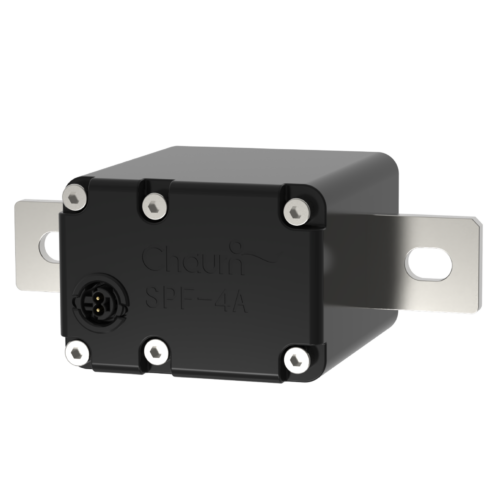
Pyrofuse Manufacturer for EV Battery and Energy Storage Systems
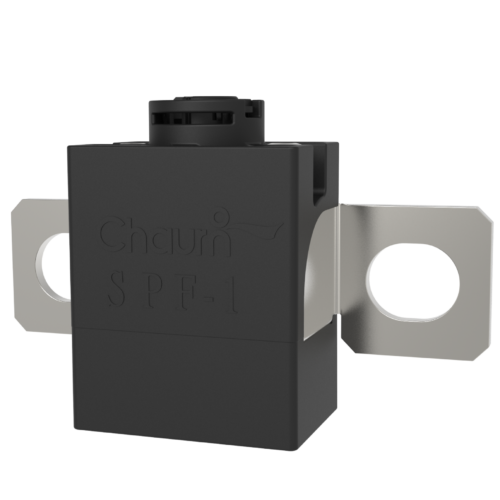
Chauron supplies pyrotechnic disconnect devices for electric vehicle batteries, battery disconnect units, energy storage systems, on-board charging systems and other high-energy DC applications. Our published product range covers 150–1000VDC and rated currents up to 400A, with model-specific interruption conditions for engineering evaluation.
Start with the system voltage and application, then verify the prospective fault current, circuit inductance, continuous-current profile, ambient temperature and required clearing time. Final selection should be based on the complete operating and fault conditions rather than voltage or rated current alone.
The table below summarizes published model data. Interruption ratings are shown with their associated voltage and circuit inductance because these conditions affect device performance. Confirm the complete duty profile with Chauron before specifying a model.
Published specifications for the Chauron SPF pyrofuse range
Model
Voltage
Rated current
Published interruption conditions
Response
Typical applications
Product details
SPF-1
150VDC
300A
32V / 2kA / 60μH; 150V / 1.2kA / 60μH
Refer to model data
EV low-voltage fuse box, household ESS, electric ship
Selection note: Published maximum values may depend on different test conditions and should not be assumed to apply simultaneously. Contact Chauron with the complete electrical and environmental profile for model confirmation.
What Is a Pyrofuse?
A pyrofuse is a one-time pyrotechnic disconnect that physically opens a high-current conductor after receiving a trigger signal from a vehicle or energy-control system. It can isolate a battery during a crash or detected electrical fault, including conditions where current may be too low for a conventional fuse to open quickly. It must be replaced after activation.
How a Pyrofuse Fits in a High-Voltage Protection System
In a typical EV or energy-storage architecture, the battery-management system, crash controller or another control unit evaluates sensor signals and commands the pyrofuse when rapid physical isolation is required. Contactors handle normal switching, while the pyrofuse provides a fast, irreversible disconnect for defined emergency conditions.
Battery pack: supplies the high-energy DC source.
Current and crash sensing: detects electrical faults or collision events.
BMS or safety controller: evaluates the event and issues the trigger command.
Pyrofuse: severs the conductor under the validated operating and fault conditions.
Contactors and load: coordinate normal switching and downstream isolation.
The exact sequence, trigger circuit and diagnostic strategy depend on the vehicle or equipment architecture. Learn more about active and passive pyrofuse triggering.
Pyrofuse Applications
EV Battery and Battery Disconnect Units
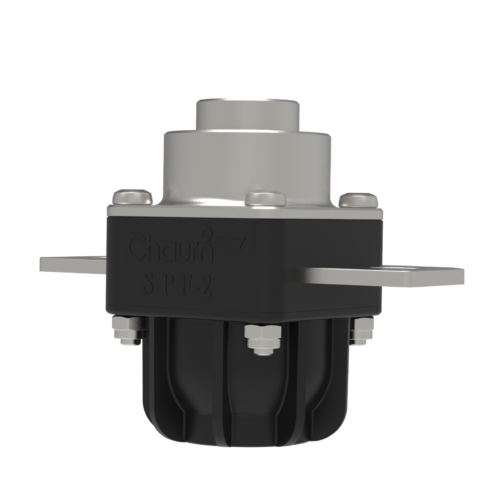
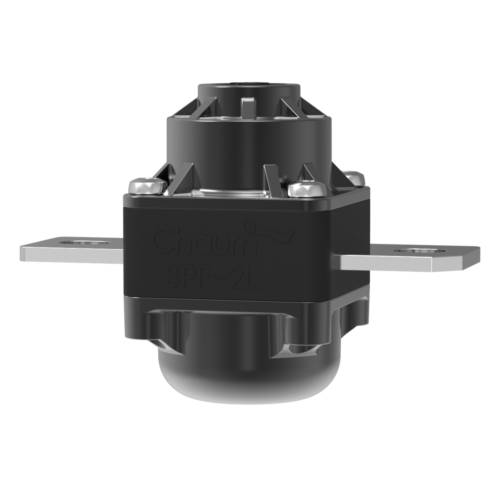
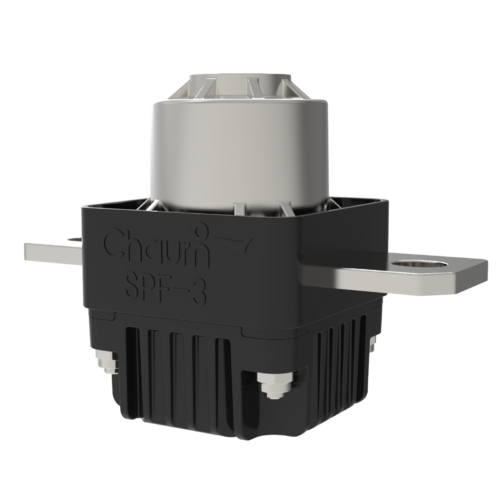
SPF-2, SPF-2L and SPF-3 cover published voltage classes from 500VDC to 1000VDC for EV battery BDU applications. Selection depends on the vehicle architecture, current profile, prospective fault current, circuit inductance and target isolation time.
OBC and Integrated Power Systems
SPF-4C is listed for EV all-in-one and on-board charging applications. Submit the electrical duty, packaging envelope, busbar interface and trigger requirements for engineering confirmation.
Energy Storage Systems
SPF-1, SPF-2 and SPF-4C have published ESS-related applications across different voltage classes. A system-level review should include charge and discharge current, ambient temperature, DC fault behavior and coordination with contactors and passive fuses.
Marine and Renewable-Energy Systems
Published applications also include electric ships and wind-power systems. Environmental, vibration, corrosion, installation and service requirements should be reviewed for each project.
How to Select a Pyrofuse
A useful selection request includes the normal operating profile and the fault-clearing target. Send the following information so the device can be evaluated as part of the complete protection system:
Maximum operating voltage and transient voltage.
Continuous current, overload profile and ambient temperature.
Minimum and maximum prospective fault current.
Circuit inductance or electrical time constant.
Required clearing time and downstream withstand limit.
Trigger, no-fire and diagnostic-current requirements.
Mounting orientation, busbar geometry and tightening torque.
Available installation envelope and dimensional drawing.
Environmental, vibration and qualification requirements.
Chauron can review the selected model against its published electrical data, dimensional information and applicable test conditions. Ask for the latest model datasheet, drawing and available test evidence during design validation. Company-level management-system or laboratory credentials should be evaluated separately from model-specific product approvals.
Pyrofuse FAQ
What is the difference between a pyrofuse and an HVDC fuse?
A conventional HVDC fuse responds to current and heat, while a pyrofuse opens after an external trigger command or a validated trigger strategy. A pyrofuse can therefore isolate a circuit during a crash or at a low-current fault condition that may not open a passive fuse quickly. The two devices may be coordinated in the same protection system.
When should an EV use a pyrofuse?
An EV may use a pyrofuse when the safety concept requires rapid, irreversible battery isolation after a collision or detected electrical event. The decision depends on the vehicle architecture, fault analysis, contactor strategy and applicable safety requirements.
Can a pyrofuse open when the circuit current is close to zero?
A triggered pyrotechnic disconnect can physically sever the conductor without waiting for overcurrent heating. Its ability to isolate a particular circuit still depends on the device design, system voltage, current direction and validated operating conditions.
What information is needed to select a 500V, 930V or 1000V pyrofuse?
Provide the maximum voltage, continuous and pulse current, temperature profile, prospective fault-current range, circuit inductance, required clearing time, trigger interface, mounting arrangement and qualification requirements. Voltage and rated current alone are not enough for final selection.
What do kA and μH mean in a pyrofuse interruption rating?
kA describes the prospective fault current in the test condition, while μH describes circuit inductance. Inductance affects the stored energy and voltage developed during current interruption, so a breaking-capacity value should always be read together with its voltage and inductance.
Can a pyrofuse be reset after activation?
No. A pyrofuse is a one-time safety device and must be replaced after activation. The cause of the trigger should also be diagnosed before the system is returned to service.
How should a pyrofuse coordinate with contactors and the BMS?
The BMS or safety controller should detect the defined event, execute the validated contactor sequence and command the pyrofuse according to the system safety concept. Trigger timing, diagnostic current, wiring integrity and post-trigger isolation must be validated at system level.
Can Chauron evaluate a custom pyrofuse requirement?
Send the electrical duty, target clearing behavior, trigger interface, installation drawing, environmental requirements and project volume. Chauron can then evaluate whether a published model or an engineering solution is suitable; feasibility depends on the complete requirement.
Share your application, maximum voltage, current and temperature profile, prospective fault current, circuit inductance, target clearing time and available installation space. Chauron’s engineering team can use these inputs to evaluate the closest published model or discuss a project-specific requirement.