
Types of electrical fuses are classified by operating voltage, construction, response speed and application. Common types include cartridge, HRC, blade, bolt-down, semiconductor, photovoltaic, automotive, thermal and resettable fuses. High-energy DC systems use specialized HVDC fuses because direct-current arcs are harder to interrupt than AC arcs. The correct type depends on the circuit, not appearance alone.
Electrical Fuse Types at a Glance
The following fuse types chart gives a practical overview before we examine each category in detail.
| Fuse type | Typical construction | Common applications | Main selection concern |
|---|---|---|---|
| Cartridge fuse | Cylindrical glass or ceramic body with end caps | Appliances, control panels, power supplies and industrial equipment | Size, speed, voltage and breaking capacity |
| HRC fuse | Sealed ceramic body with arc-quenching filler | Industrial distribution, motors, transformers and power equipment | Utilization category and fault-current rating |
| Blade fuse | Plastic body with flat plug-in terminals | Passenger vehicles and low-voltage accessories | Package family, amperage and voltage |
| Bolt-down fuse | Metal terminals secured by studs or bolts | Batteries, inverters, EVs and high-current distribution | Terminal geometry, torque, heat rise and DC interruption |
| Semiconductor fuse | Very fast current-limiting construction | Inverters, rectifiers, drives and power semiconductors | Low let-through energy and coordination |
| PV fuse | DC fuse designed for photovoltaic fault conditions | PV strings, arrays, combiner boxes and inverters | Maximum DC voltage and low-current fault clearing |
| EV/HVDC fuse | High-voltage DC fuse with strong arc control | EV batteries, ESS, chargers and DC power systems | Load cycling, time constant and breaking capacity |
| Thermal fuse | Temperature-sensitive one-time cutoff | Transformers, motors, heaters and appliances | Operating temperature and thermal placement |
| Resettable fuse | PTC device that increases resistance when hot | Electronics, ports, batteries and low-power circuits | Hold current, trip current and reset behavior |
| Pyrofuse | Externally triggered one-time disconnect | EV, ESS and other intelligent battery systems | Trigger strategy, breaking duty and diagnostics |
A fuse name often describes only one dimension. For example, a cartridge fuse describes the package, while “fast acting” describes the response and “gG” describes an application category. A single product can belong to several categories at once.
What Is an Electrical Fuse?
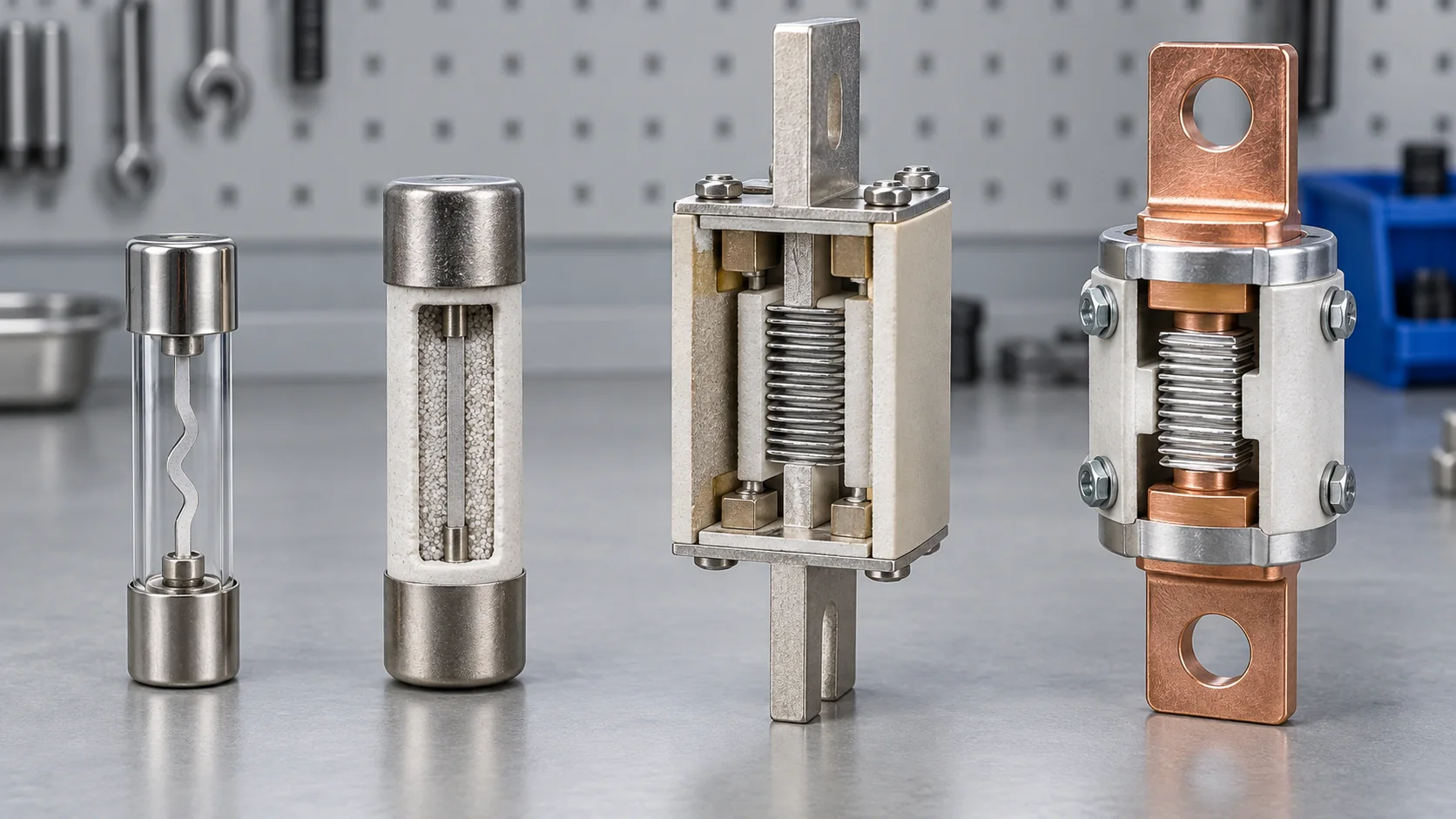
An electrical fuse is an overcurrent protection device installed in series with a circuit. Its current-carrying element heats when current flows. If an overload or short circuit produces enough energy for long enough, the element melts and opens the circuit.
Opening the element is only part of the job. A fuse must also control and extinguish the arc that forms after the metal separates. The fuse body, element geometry and filler material are therefore critical, especially in high-voltage and high-fault-current systems.
Most fuses are one-time devices. Once they operate, they must be replaced after the underlying fault has been found and corrected. A fuse is different from a circuit breaker, which normally opens mechanical contacts and can usually be reset. Our guide to fuse, circuit breaker and protection symbols explains how these devices appear on electrical drawings.
How Are Fuses Classified?
Engineers commonly classify fuses in four ways:
- By current type: AC fuse or DC fuse
- By voltage class: low-voltage, high-voltage or application-specific high-voltage DC fuse
- By construction: cartridge, blade, bolt-down, SMD, rewireable or thermal
- By protection duty: general-purpose, motor, semiconductor, photovoltaic, battery or automotive protection
This layered classification is more useful than a single list because it reflects how engineers actually select a fuse. The first question is not “What shape fits?” but “What fault must the device safely interrupt?”
AC Fuses and DC Fuses
AC Fuses
Alternating current crosses zero every half-cycle. This natural current zero helps an arc extinguish after the fuse element melts. AC fuses are widely used in building distribution, motors, transformers, industrial control and power-conversion equipment.
An AC voltage rating must not be assumed to apply to DC. The product datasheet and applicable approval must explicitly support the intended circuit.
DC Fuses
Direct current does not provide a natural current zero. Once an arc forms, the fuse must create enough separation and arc voltage to force the current to stop. DC fuses may therefore use longer elements, multiple restrictions, ceramic bodies and arc-quenching filler.
DC performance also depends on circuit inductance. An inductive circuit can continue driving current during interruption, increasing the energy the fuse must absorb. This makes voltage rating, prospective fault current and circuit time constant essential selection inputs.
Cartridge Fuse Types
“Cartridge fuse” is one of the highest-volume fuse searches because the term covers many products. A cartridge fuse encloses the element in a cylindrical or rectangular insulating body. The enclosure protects the element and helps contain the interruption process.
Glass Cartridge Fuses
Glass cartridge fuses allow visual inspection of the element. They are common in instruments, small power supplies, appliances and older electronic equipment. Similar-looking glass fuses can have different current, voltage and time-delay ratings, so visual size alone does not establish compatibility.
Ceramic Cartridge Fuses
Ceramic cartridge fuses tolerate higher temperature and can provide greater interruption capability than basic glass designs. Many contain filler that absorbs heat and helps extinguish the arc. They are used in appliances, industrial controls, power supplies and higher-energy circuits.
D-Type Cartridge Fuses
D-type systems use a cartridge, carrier, base and gauge component designed to limit incorrect replacement. They have been used in low-voltage distribution systems and industrial installations.
HRC and NH Fuses
HRC means high rupturing capacity. These sealed fuses are designed to interrupt high prospective fault currents without allowing uncontrolled arcing or case rupture. NH is a common industrial fuse system with blade contacts and standardized sizes.
HRC and NH fuses are used in distribution boards, motor circuits, transformers, industrial machinery and power-conversion equipment. Terms such as gG, aM and aR describe different protection duties. They should never be treated as interchangeable merely because the fuse fits the same holder.
Automotive Blade, Cartridge and Bolt-Down Fuses
Automotive electrical systems use several package families because a lighting circuit, cooling fan, starter circuit and traction battery have very different requirements.
Blade Fuses
Blade fuses use flat terminals that plug into a fuse box. Standard ATO/ATC, Mini, low-profile Mini, Micro2, Micro3 and Maxi are common families. Their color often indicates amperage within a package family, but the printed rating and vehicle documentation should control replacement.
Automotive Cartridge Fuses
JCASE, low-profile JCASE, MCASE and PAL fuses provide compact protection for medium- and high-current vehicle circuits. Terminal layout, body size and interrupting performance vary, even when the devices look similar.
Bolt-Down Fuses
MEGA, MIDI, ANL and other bolt-down designs protect batteries, alternators, inverters and power-distribution circuits. A bolted connection provides mechanical security and low contact resistance, but correct torque and clean contact surfaces are essential.
For a detailed comparison of vehicle packages, see our automotive fuse types guide.
Electronic, SMD and Resettable Fuses
SMD and Chip Fuses
Surface-mount fuses protect compact electronic assemblies. They are available in fast-acting, time-delay, pulse-tolerant and high-current versions. Selection must account for operating current, ambient temperature, inrush pulses, board layout and soldering profile.
Axial and Radial Leaded Fuses
Leaded fuses mount directly to a printed circuit board. They can save space and resist vibration, but field replacement usually requires soldering. They are common in power supplies, chargers, appliances and electronic control modules.
Resettable PTC Devices
A polymeric positive temperature coefficient device, often called a resettable fuse, does not normally melt open. Its resistance rises sharply as it heats, limiting current. After power is removed and the device cools, it can return toward its low-resistance state.
PTCs are useful in low-power electronics where automatic recovery is desirable. They are not direct replacements for high-breaking-capacity fuses, and a tripped PTC can still pass a small current.
Thermal Fuses and Rewireable Fuses
Thermal Fuses
A thermal fuse responds primarily to temperature rather than electrical current. It opens permanently when its body reaches a specified temperature. Thermal fuses are installed close to heaters, motor windings, transformers and other heat-producing components.
Placement is part of the design. A thermal fuse cannot protect the intended component if heat does not reach it quickly enough.
Rewireable Fuses
Rewireable or semi-enclosed fuses use a replaceable fuse wire mounted in a carrier. They remain in some older installations, but their performance depends heavily on using the correct wire and assembly. Replacing the element with an unapproved conductor can remove the intended protection.
Semiconductor and High-Speed Fuses
Power semiconductors can be damaged before a general-purpose fuse clears a fault. Semiconductor fuses use carefully designed elements to limit peak current and total let-through energy. They are used with diodes, thyristors, IGBTs, power modules, rectifiers, inverters and variable-speed drives.
Key selection values include pre-arcing I²t, total clearing I²t, peak let-through current, voltage rating and minimum interrupting current. Coordination requires comparing the fuse data with the semiconductor’s short-circuit withstand and the circuit’s actual fault-current waveform.
Photovoltaic Fuses
PV strings can feed reverse current into a faulted string. A photovoltaic fuse must interrupt DC current at the system voltage and may need to clear relatively low multiples of normal operating current. PV fuses are used in string circuits, combiner boxes, array cables and inverter inputs.
Engineers should account for maximum open-circuit voltage at the lowest expected temperature, string current, parallel-string contribution, environmental derating and the equipment manufacturer’s requirements.
EV and High-Voltage DC Fuses
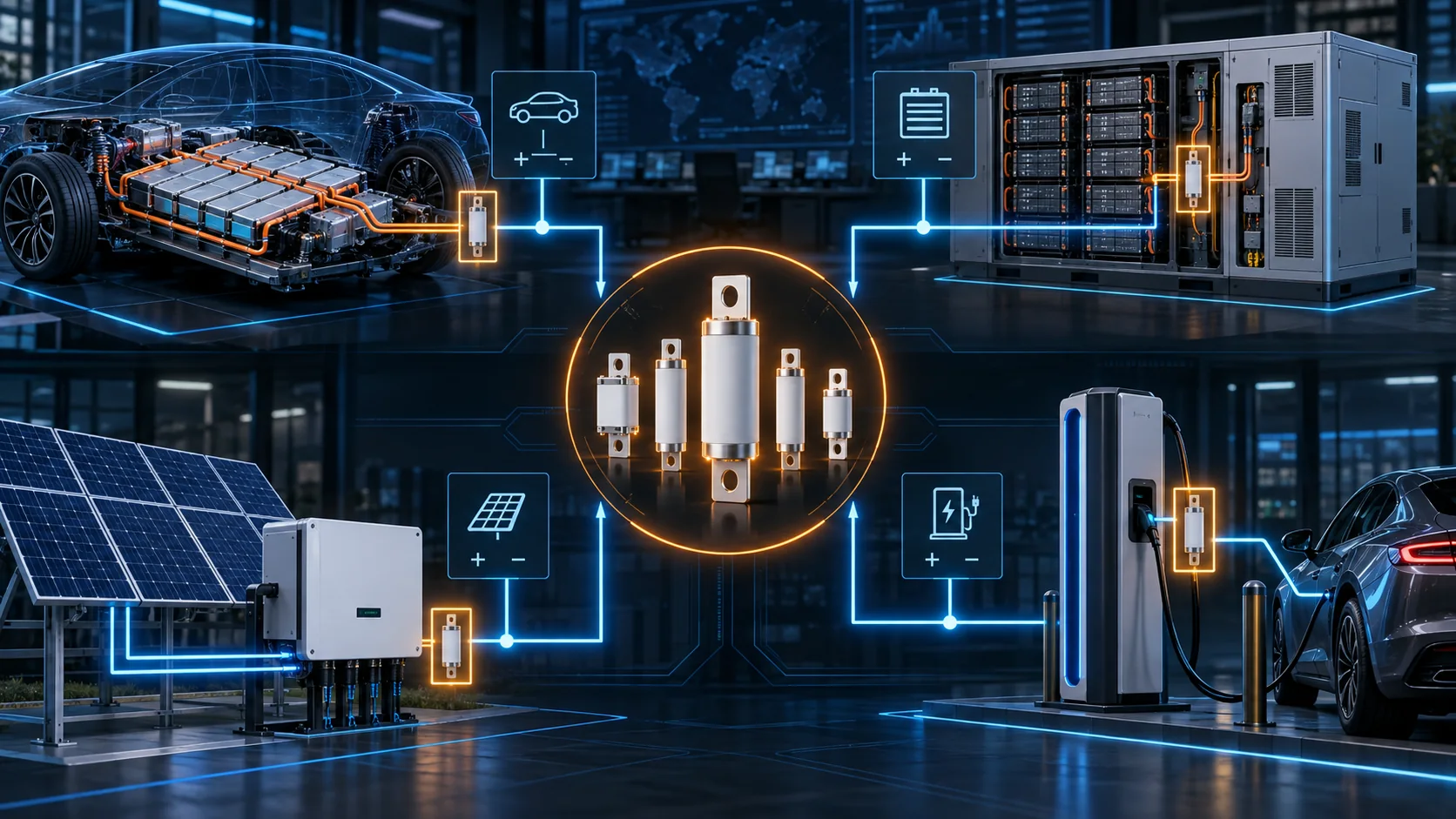
Electric vehicles and battery energy storage systems combine high voltage, high current, repeated power pulses and substantial stored energy. Their fuses protect battery packs, inverters, traction motors, onboard chargers, DC-DC converters, air-conditioning compressors and high-voltage distribution units.
An EV or HVDC fuse must survive normal acceleration, regenerative braking and fast-charging pulses without nuisance operation. It must still clear dangerous faults within the withstand limits of cables, busbars, contactors and power semiconductors.
Important engineering inputs include:
- Maximum operating voltage and transient voltage
- Continuous RMS current at actual ambient temperature
- Pulse magnitude, duration and repetition
- Prospective minimum and maximum fault current
- Circuit inductance or L/R time constant
- Required breaking capacity
- Pre-arcing and total clearing I²t
- Peak let-through current
- Terminal temperature and permissible power loss
- Vibration, shock, altitude and cooling conditions
- Coordination with contactors, busbars and downstream devices
Chauron develops HVDC fuse products for electric vehicles, energy storage, charging infrastructure, photovoltaic systems, data centers and other new-energy applications.
Is a Pyrofuse a Type of Fuse?
A Pyrofuse performs permanent circuit isolation, but it operates differently from a conventional thermal fuse. A conventional fuse reacts to current-generated heat. A Pyrofuse receives an external trigger from a battery management system, crash controller or other safety controller and mechanically severs the current path.
This commanded response can disconnect a battery after a crash, insulation warning or thermal event even when current has not reached a conventional fuse’s melting threshold. A Pyrofuse does not replace every passive fuse function. Many systems use both devices as coordinated protection layers.
Read what a Pyrofuse is and our fuse vs. Pyrofuse comparison for a deeper explanation.
Fuse Utilization Categories
Construction tells you what a fuse looks like. A utilization category tells you what part of the current range it is designed to protect.
| Category | General meaning | Typical use |
|---|---|---|
| gG | Full-range general-purpose protection | Cables and general distribution |
| aM | Partial-range motor-circuit protection | Short-circuit protection used with motor overload protection |
| aR | Partial-range semiconductor protection | Power semiconductors and converters |
| gR | Full-range semiconductor protection | Semiconductor circuits requiring overload and short-circuit coverage |
| gPV | Full-range photovoltaic protection | PV strings and arrays |
The IEC 60269-1:2024 standard provides general requirements for enclosed current-limiting low-voltage fuse links. Application-specific parts and regional standards add further requirements. Always verify the exact standard and approval stated on the product datasheet.
How to Select the Right Fuse Type
1. Define the Protected Circuit
Identify the source, load, conductor, switching devices and components that the fuse must protect. A fuse selected only from the load’s nominal current can fail to protect the most vulnerable part of the circuit.
2. Confirm AC or DC Voltage
The fuse voltage rating must equal or exceed the maximum circuit voltage under all operating conditions. Use a product with an explicit DC rating for a DC circuit.
3. Calculate the Real Load Profile
Record continuous current, peak current, pulse duration, repetition rate and expected overloads. Motors, inverters, chargers and batteries rarely operate at one constant current.
4. Establish the Fault-Current Range
Determine both the maximum prospective short-circuit current and the minimum fault current that must be cleared. Breaking capacity must exceed the available fault current at the installation point.
5. Check Time-Current Coordination
Compare the fuse time-current curve with normal pulses and with the withstand curves of cables, contactors, busbars and semiconductor devices. The fuse should tolerate normal operation and clear faults before protected components exceed their limits.
6. Apply Environmental Derating
Ambient temperature, enclosure temperature, airflow, altitude, vibration and terminal conditions affect fuse behavior. Use manufacturer data and application testing rather than a fixed current multiplier for every design.
7. Verify Mechanical Integration
Check dimensions, mounting method, terminal spacing, bolt size, installation torque, creepage and clearance. A fuse that fits mechanically can still be electrically unsuitable.
8. Confirm Standards and Qualification
Match the applicable fuse standard, vehicle or equipment qualification, market approval and service requirements. Certification should be verified for the specific series and rating.
Fuse Type Selection by Application
| Application | Common starting point | Additional questions |
|---|---|---|
| Household appliance | Cartridge or thermal fuse | Is the hazard overcurrent, overheating or both? |
| Industrial motor | HRC/NH or cartridge fuse | Is separate overload protection provided? |
| Power semiconductor | aR/gR high-speed fuse | What are the device I²t and short-circuit withstand limits? |
| Passenger-vehicle low-voltage circuit | Blade or automotive cartridge fuse | What package and OEM specification apply? |
| EV traction battery | Bolt-down HVDC fuse, sometimes with Pyrofuse | What are the load cycles, fault current and crash-isolation strategy? |
| Battery energy storage | HVDC fuse or high-speed fuse | What are the rack voltage, parallel paths and DC time constant? |
| DC fast charger | High-speed DC fuse | How should the fuse coordinate with power modules and upstream protection? |
| Photovoltaic string | gPV fuse | What are the cold open-circuit voltage and reverse-current contribution? |
| Data-center DC bus | High-speed DC fuse or coordinated active disconnect | What are the source energy, semiconductor limits and required clearing time? |
Common Fuse Selection Mistakes
Selecting by Current Rating Alone
Two fuses with the same ampere rating can have different voltage ratings, time-current curves, breaking capacities and I²t values.
Using an AC Fuse in a DC Circuit
An AC marking does not demonstrate DC arc-interruption performance. Use the exact DC rating and tested conditions in the datasheet.
Treating Every Cartridge Fuse as Equivalent
Cartridge describes the enclosure. Glass, ceramic, HRC, time-delay and semiconductor cartridges serve different duties.
Increasing the Ampere Rating After Repeated Operation
A repeatedly blown fuse indicates a circuit problem, incorrect application or selection issue. Increasing the rating can leave the wiring or equipment unprotected.
Ignoring Connections and Temperature
Loose terminals create resistance and heat. Elevated ambient temperature and poor cooling can also change current-carrying performance.
Replacing a Pyrofuse Without Diagnosing the Trigger Event
A deployed Pyrofuse may indicate a crash or another safety event. The trigger circuit, controller diagnostics and protected system must be checked before replacement.
Frequently Asked Questions
What are the main types of electrical fuses?
The main types include cartridge, HRC, blade, bolt-down, semiconductor, photovoltaic, automotive, thermal, SMD and resettable fuses. EV and energy-storage systems also use specialized HVDC fuses and, in some architectures, externally triggered Pyrofuses.
What is the most common fuse category?
There is no single most common category across all applications. Cartridge fuses are widespread in electrical and electronic equipment, blade fuses dominate many vehicle low-voltage circuits, and HRC or NH fuses are common in industrial distribution.
What is the difference between a cartridge fuse and an HRC fuse?
Cartridge describes an enclosed package. HRC describes the ability to interrupt high fault current safely. Many HRC fuses use cartridge-style construction, but a basic glass cartridge fuse is not automatically an HRC fuse.
What is the difference between AC and DC fuses?
AC current passes through natural current zeros that help extinguish an arc. DC does not. DC fuses therefore require verified DC voltage and interruption performance, and often use more substantial arc-control construction.
Which fuse type is used in electric vehicles?
EVs use low-voltage blade and cartridge fuses for auxiliary circuits and high-voltage DC fuses for traction batteries, inverters, chargers and other HV loads. Some vehicles also use a Pyrofuse for commanded emergency isolation.
Is a resettable fuse the same as a circuit breaker?
No. A resettable PTC limits current by increasing resistance as it heats. A circuit breaker opens contacts through a trip mechanism. Their electrical behavior, leakage, reset conditions and interruption capabilities differ.
Can two fuses with the same amperage be interchanged?
Not necessarily. Voltage rating, AC/DC approval, breaking capacity, response speed, I²t, package, terminal design and applicable standard must also match.
How do I choose an HVDC fuse?
Start with maximum voltage, continuous and pulsed current, ambient temperature, minimum and maximum fault current, circuit time constant, required clearing time and coordination limits. Then verify mechanical integration, environmental qualification and certification for the specific application.
Choosing a Fuse for a New-Energy Power System
The best fuse is the one that coordinates with the complete electrical system. For an EV, ESS, charging pile, photovoltaic installation or data-center DC bus, a useful selection request should include:
- Maximum system voltage
- Continuous current and ambient temperature
- Peak-current waveform and duty cycle
- Prospective fault-current range
- Circuit inductance or time constant
- Required clearing time and I²t limit
- Mounting space, busbar dimensions and terminal requirements
- Applicable standards and qualification targets
Chauron develops and manufactures high-performance fuses and Pyrofuse devices for new-energy power protection. Send these system parameters through the Chauron contact page to request product matching, technical review, samples or a customized solution.