
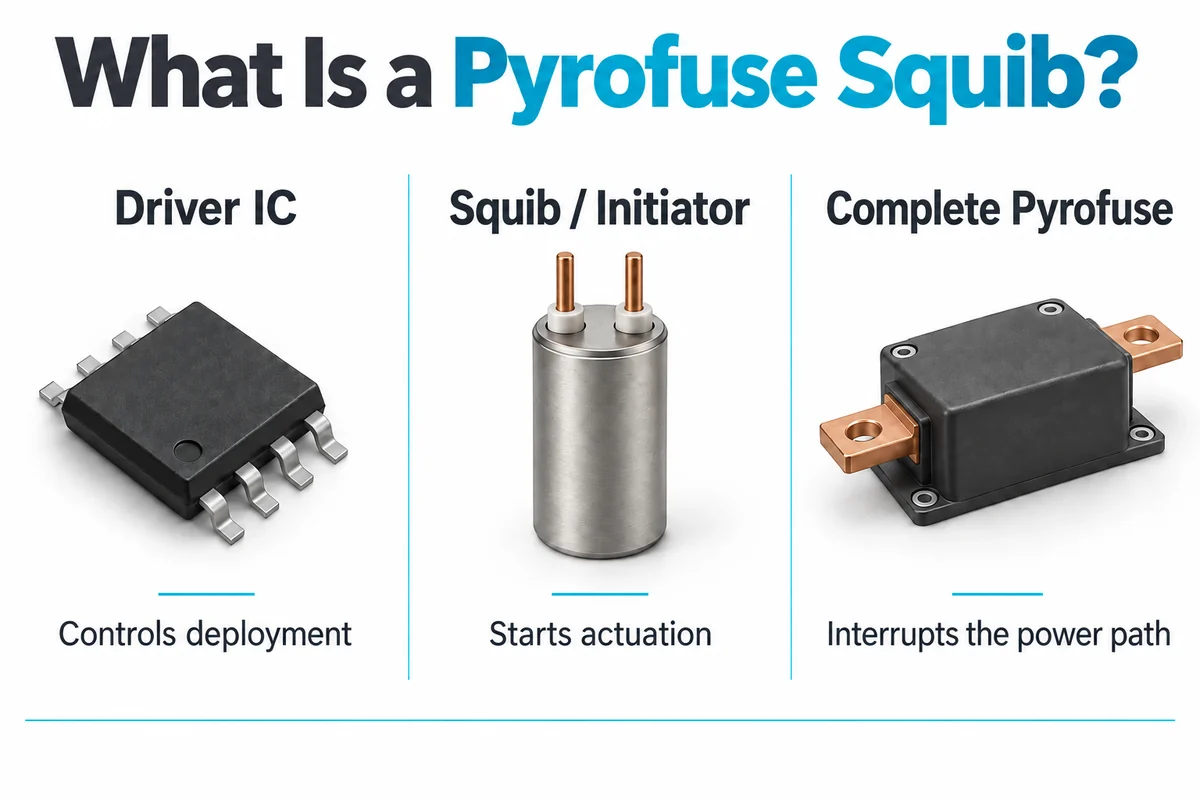
A pyrofuse squib is the electrically activated initiator that starts a pyrotechnic battery disconnect. When commanded by a suitable driver, it initiates a reaction that operates the disconnect mechanism. The squib starts the action; the complete pyrofuse assembly opens the high-current conductor and manages interruption of the power circuit.
That distinction matters whether you are reading a vehicle fault message or specifying an EV battery protection system. The squib, its driver, and the power disconnect each have a different job.
I. What Is a Squib Inside a Pyrofuse?
In this context, squib, igniter and pyrotechnic initiator refer to the activation component. Terminology and construction vary between manufacturers, but its purpose is to convert an electrical deployment command into the start of a mechanical disconnection event.
The initiator sits within a larger device containing a current-carrying conductor, an actuator and an insulating enclosure. It is not the conductor that carries the battery’s normal operating current. For background on the complete device, see Chauron’s explanation of what a pyrofuse is.
II. How Does a Pyrofuse Squib Work?
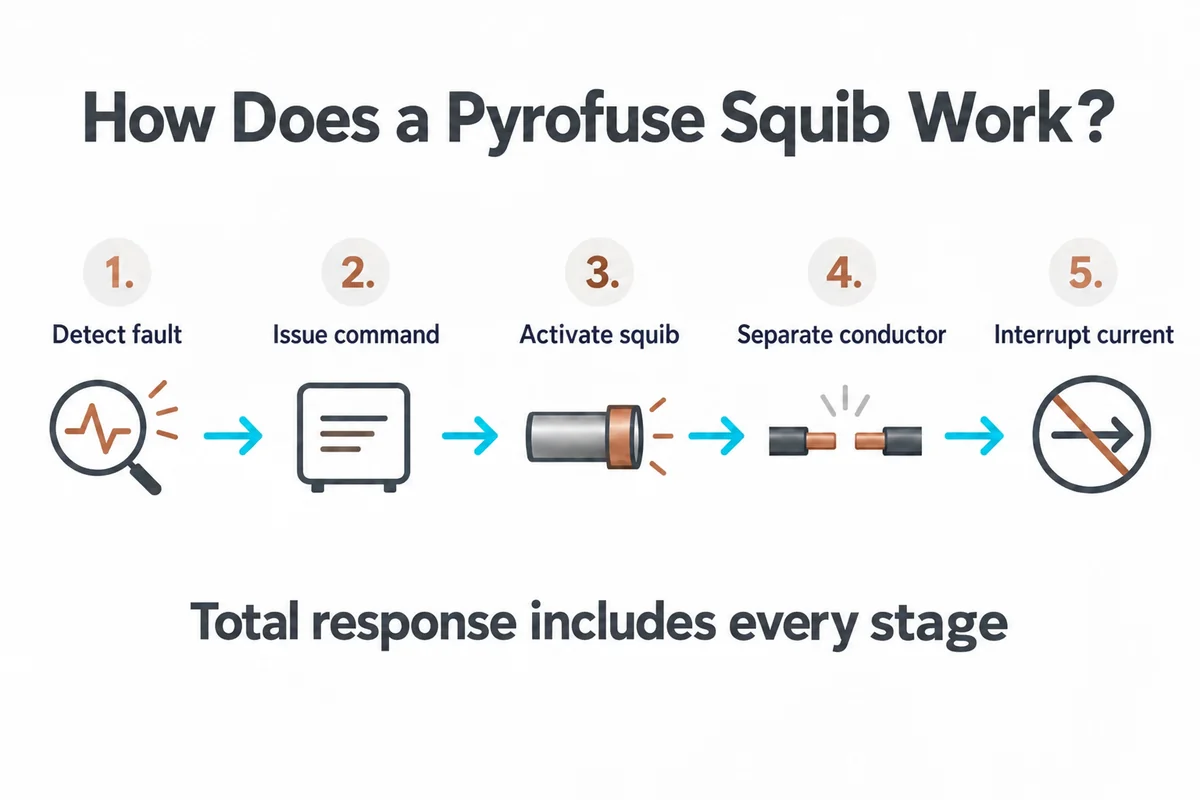
A typical externally triggered design follows a short chain of events: a protection system identifies a condition requiring isolation, a driver commands the initiator, and the actuator physically separates the conductor.
Daicel describes a design in which an ECU command activates an igniter; generated gas drives a piston that separates the busbar. This illustrates the principle, although the mechanism and interruption arrangement differ between products. Source: Daicel Pyro-Fuse.
Separating the conductor is only part of interrupting a high-voltage DC circuit. The assembly must also deal with the electrical conditions during opening and maintain adequate insulation afterward. Sensata’s PyroFuse documentation, for example, distinguishes breaking capacity from post-isolation resistance. Those are assembly-level characteristics, not standalone squib ratings.
Deployment time and total fault-clearing time are not interchangeable. Detection, decision-making, driver response, actuation and current interruption all contribute to the system response. A mechanical opening-time figure alone does not establish how quickly a particular battery fault will be cleared.
III. Squib vs. Squib Driver vs. Complete Pyrofuse
These three terms describe different parts of the protection system.
| Component | Main function | What engineers evaluate |
|---|---|---|
| Squib or initiator | Starts pyrotechnic actuation | Approved firing envelope, no-fire limits, environmental and interface requirements |
| Squib driver | Controls and monitors the initiator circuit | Output regulation, diagnostics, command integrity and available deployment energy |
| Complete pyrofuse | Disconnects the high-current power path | DC interruption capability, continuous-current suitability, insulation and mechanical integration |
| BMS or safety controller | Determines when isolation is required | Detection coverage, fault response and system-level safety logic |
Texas Instruments describes its DRV3901-Q1 as a squib driver integrating current regulation, diagnostic and protection functions. The distinction is useful: the chip drives the initiator; it does not itself sever the battery busbar. Source: TI DRV3901-Q1.
Likewise, a connector that physically fits is not evidence of electrical compatibility. The initiator, driver and complete disconnect must be assessed together using the applicable documentation.
IV. Is a Pyrofuse Squib the Same as a Normal Fuse?
No. A conventional fuse interrupts current when its fusible element melts under the relevant overload or short-circuit conditions. An externally commanded pyrotechnic disconnect can be activated by a control signal, including when the reason for isolation is not an overcurrent at that location.
For example, Autoliv describes externally triggered pyro safety switches used for electrical malfunctions and vehicle crash events. This makes the activation decision part of the wider safety architecture.
The practical difference between a fuse and a pyrofuse is therefore about triggering and protection coordination as well as opening speed. A pyrofuse does not automatically replace every conventional fuse or contactor in a battery system.
Some products combine active and passive protection functions. PEC explicitly lists a product combining a melting fuse with a pyroswitch. Engineers should check the actual architecture rather than infer it from the word “pyrofuse.”
Chauron’s guide to active and passive pyrofuse triggering explains this distinction at system level.
V. What Does a Pyrofuse Squib Fault Mean?
A squib-related fault message identifies a problem reported by the deployment-circuit monitoring system. It does not, by itself, prove that the main battery conductor has already been disconnected. The exact meaning depends on the vehicle, controller and diagnostic code.
| Diagnostic description | What needs to be distinguished |
|---|---|
| Open circuit or excessive resistance | An initiator-circuit discontinuity versus connector, harness or monitoring issues |
| Low resistance or short circuit | An unintended electrical path versus the expected monitored load |
| Driver or supply fault | A deployment-control issue versus a problem with the disconnect itself |
| Deployment recorded | A commanded event versus confirmed physical interruption, as defined by the manufacturer |
The table is a conceptual interpretation, not a vehicle-specific fault-code guide. Diagnostic features differ: TI’s driver documentation includes squib and energy-reservoir monitoring, while ST describes controlled deployment and diagnostic functions in its pyrofuse-driver documentation.
For a vehicle repair, use the manufacturer’s diagnostic procedure and approved replacement assembly. Do not apply an external power source, bypass the initiator circuit or probe it with an ordinary meter unless the manufacturer explicitly authorizes that equipment and method.
VI. How Engineers Match a Squib to a Pyrofuse System
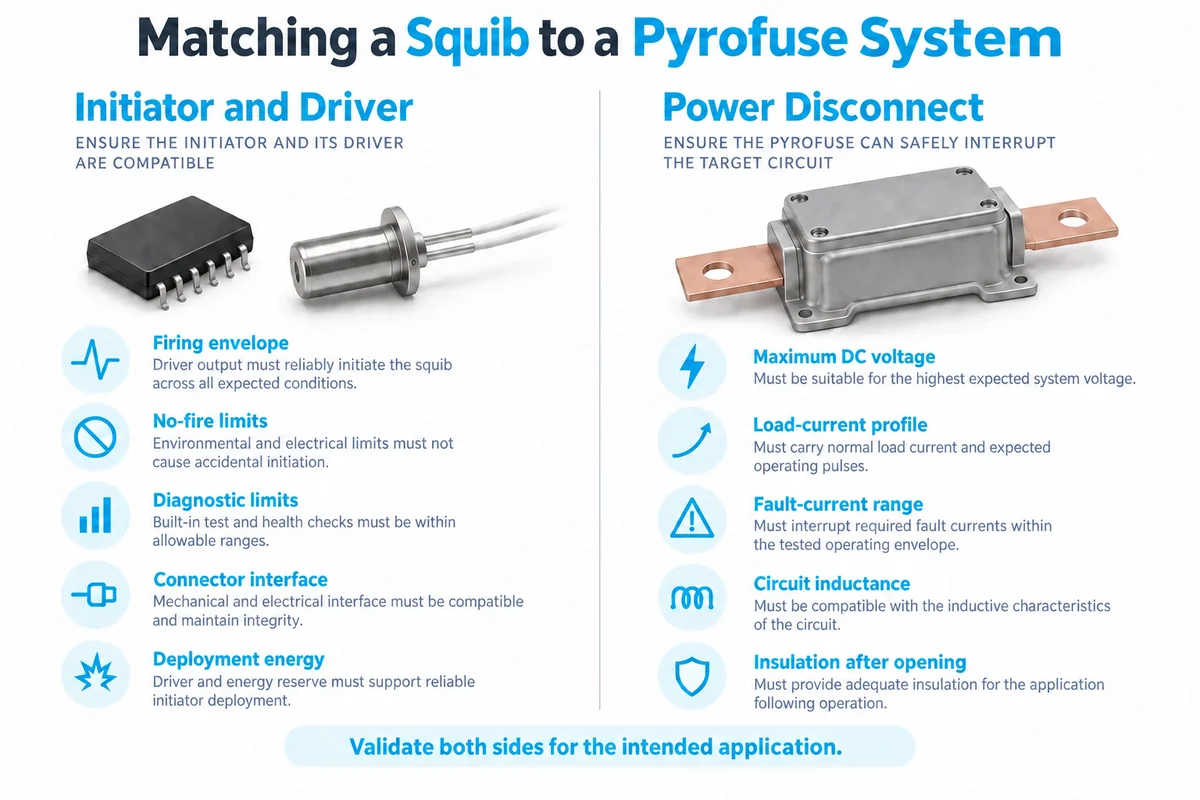
Selection requires two separate checks: the initiator interface must be compatible with its driver, and the complete disconnect must be suitable for the power circuit. A correct result on one side does not establish the other.
Ask the supplier for the approved initiator and driver interface requirements, including firing and no-fire envelopes, diagnostic limits, connector details and operating conditions. Review how the safety system preserves deployment capability during supply disturbances. ST’s AN6194 discusses a driver architecture with an external energy reserve and controlled firing profiles, illustrating why this assessment extends beyond the initiator alone. Source: ST AN6194.
For the main power path, review maximum operating voltage, continuous load and pulses, prospective fault current, circuit inductance, environmental conditions and required post-interruption insulation. Product ratings must be read with their test conditions; a current value without its associated voltage and circuit conditions is insufficient for selection.
Chauron’s Pyrofuse product range provides a starting point for comparing complete disconnect devices. A specific option such as the SPF-2L Pyrofuse still needs an application-specific review of both its main-circuit capability and triggering interface. These links refer to complete products, not a claim that Chauron sells interchangeable standalone squibs.
VII. Frequently Asked Questions
Is a pyrofuse squib the same as an airbag squib?
Both terms can describe electrically initiated pyrotechnic components, but they operate different assemblies. An airbag initiator supports restraint deployment; a pyrofuse initiator supports electrical disconnection. Similar terminology does not establish interchangeability. Connector design, approved electrical characteristics and environmental requirements must match the specific application.
Does the squib carry the EV battery’s high current?
In a typical externally triggered pyrofuse, the main load current flows through the power conductor. The initiator has a separate deployment interface. This is why continuous-current and DC breaking ratings belong to the complete power disconnect, while initiator-interface requirements are evaluated separately.
Can a deployed pyrofuse squib be reset?
A deployed pyrotechnic initiator is a one-time component. Clearing a diagnostic code does not restore the consumed initiator or reconnect a mechanically separated conductor. Replacement scope depends on the assembly and the manufacturer’s service instructions; it may involve replacing the complete disconnect rather than a separate initiator.
Does a squib fault mean the pyrofuse has fired?
Not necessarily. A monitored circuit fault and a deployment event are different findings. The diagnostic code must be interpreted using the relevant controller and vehicle documentation. Confirming the state of the high-current path requires the manufacturer’s approved procedure, not an assumption based on the wording of an error message.
Does every pyrofuse need an external BMS command?
No single triggering architecture describes every product. Externally triggered devices receive a command from an appropriate control system; some designs provide additional internal or passive activation functions. The product specification determines which triggers are available and what external monitoring and control are still required.
Can one squib specification cover both 400V and 800V batteries?
Battery voltage alone cannot answer that question. The initiator’s electrical interface and the disconnect’s high-voltage interruption capability are separate requirements. Even if an initiator interface is shared, each complete assembly and application must satisfy the relevant voltage, current, insulation and interruption conditions.
VIII. Discuss Your Pyrofuse Application with Chauron
For an EV battery or energy-storage project, prepare the maximum system voltage, load-current profile, expected fault conditions, triggering architecture, installation constraints and required validation documents. Contact Chauron for Pyrofuse selection support to discuss the complete disconnect and the interface information needed for your engineering review.