
A special fuse is an application-specific or customized fuse used when an ordinary catalog product cannot fully satisfy a circuit’s electrical, mechanical, environmental or certification requirements.
Depending on the supplier and application, “special fuse” may refer to a high-voltage DC fuse, semiconductor fuse, railway fuse, legacy replacement fuse or custom-dimension fuse. It is a broad commercial and engineering term rather than a complete technical specification.
Selecting one requires more than choosing a current rating. Engineers must consider system voltage, available fault current, circuit time constant, current profile, required clearing behavior, mounting interface, temperature and applicable standards.
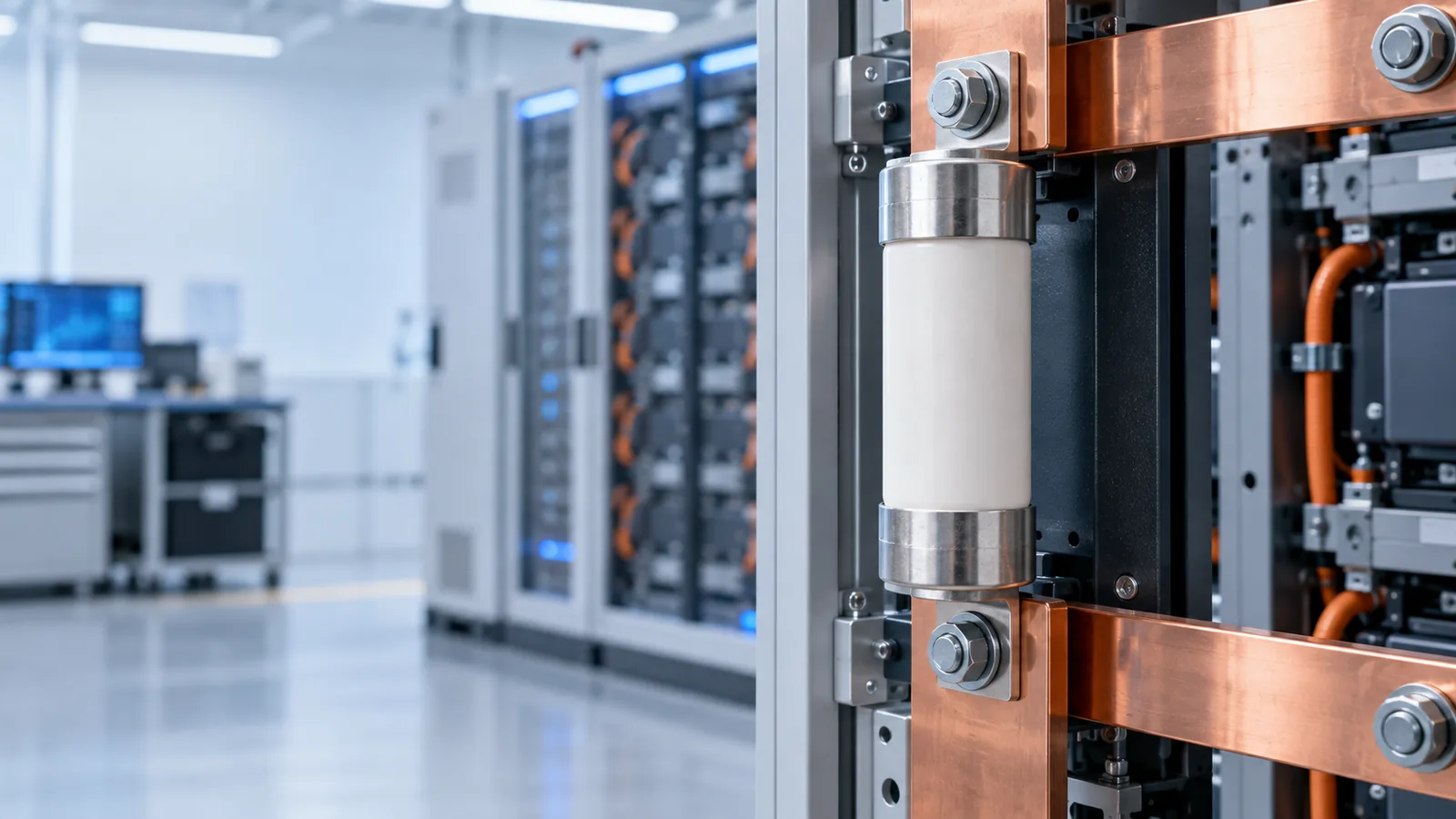
What Makes a Fuse a Special Fuse?
A fuse becomes “special” when its intended duty involves requirements that a standard general-purpose product does not adequately address. Typical examples include:
- Unusual AC or DC operating voltage.
- High prospective fault current or demanding battery fault waveforms.
- Repeated current pulses and frequent load cycling.
- Restricted installation space or nonstandard terminals.
- High temperature, vibration or sealing requirements.
- Coordination with sensitive power semiconductors.
- Replacement of an obsolete component.
- Application-specific testing and approval requirements.
Suppliers use the term differently, so a request for a “500 A special fuse” is incomplete. The fuse must carry the normal load and interrupt the defined fault duty. For a broader introduction to construction and protection categories, see our guide to types of electrical fuses.
What Are the Main Types of Special Fuses?
| Type | Main purpose | Typical applications | Critical selection factors |
|---|---|---|---|
| High-voltage DC fuse | Interrupt high-energy DC faults | EVs, energy storage, charging and DC distribution | DC voltage, fault current, L/R and breaking capacity |
| Semiconductor fuse | Limit fault stress on power devices | Inverters, rectifiers, converters and drives | Total clearing I²t, peak let-through current and coordination |
| Battery fuse | Protect battery-connected conductors and equipment | EV batteries, industrial batteries and ESS | Current cycling, state-of-charge-dependent faults and DC interruption |
| Photovoltaic fuse | Clear faults under PV circuit conditions | Strings, arrays and combiner boxes | Maximum DC voltage, reverse current and outdoor conditions |
| Railway or traction fuse | Meet traction protection and installation requirements | Rolling stock and railway auxiliary circuits | Voltage, time constant, vibration and duty cycle |
| Legacy replacement fuse | Replace a discontinued component | Older machinery and installed equipment | Electrical equivalence, terminals, dimensions and holder compatibility |
| Custom fuse | Meet a defined combination of requirements | OEM equipment and new power-system designs | Complete electrical, mechanical and environmental specification |
| Pyrofuse | Provide externally triggered, one-time isolation | Battery disconnect units and intelligent protection systems | Trigger interface, interruption duty and total system response |
These categories overlap: a battery fuse may also be a customized HVDC fuse. For high-voltage DC applications, review Chauron’s HVDC fuse product range against your circuit requirements before deciding whether a custom design is needed.
When Is a Custom Fuse Necessary?
Start with available catalog products. Customization is useful when a verified requirement cannot be met by a suitable existing design.
Electrical requirements fall outside the available range
A combination of operating voltage, continuous current, pulse endurance and interruption behavior may require a different design. These characteristics must be evaluated together: increasing one rating does not automatically preserve the others.
A standard fuse does not fit the installation
Busbar spacing, terminal orientation, bolt dimensions and enclosure clearance can constrain selection. Changing a terminal or body dimension may also change heat dissipation and electrical clearances, so a mechanical modification still needs engineering validation.
The operating environment is demanding
High ambient temperature, vibration, moisture, altitude and limited airflow can affect service performance. Specify the actual conditions around the fuse, including its enclosure and cooling arrangement.
An obsolete fuse needs replacement
A replacement must provide appropriate protection as well as fit the holder. Supply the original part number, datasheet, drawings and circuit information. A photograph can help identify the package but cannot establish electrical equivalence.
How Do You Select a Special Fuse?
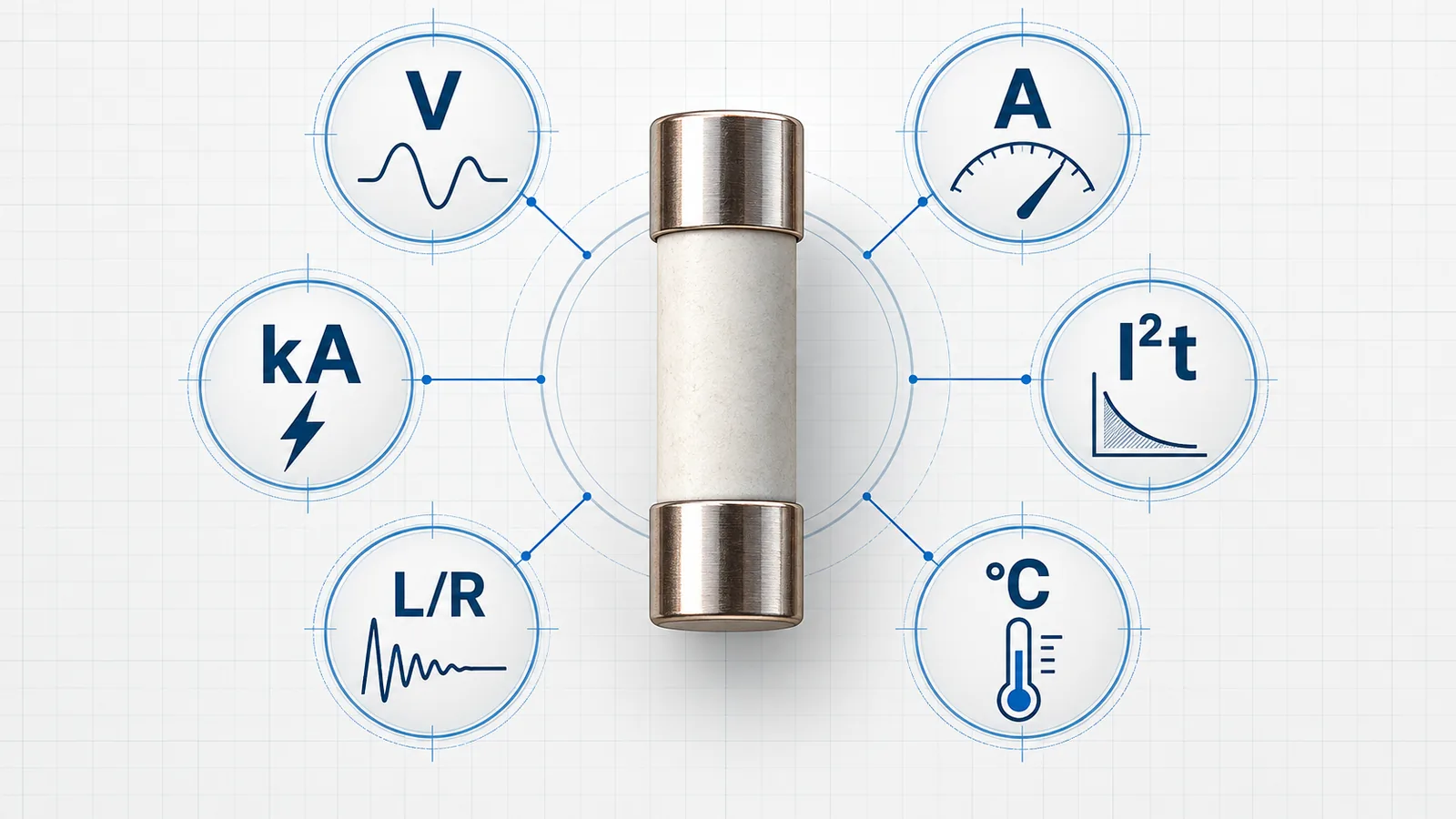
1. Establish the maximum operating voltage
The fuse’s applicable voltage rating must cover the specified circuit voltage. Identify AC or DC operation and assess relevant transient conditions separately. Do not assume an AC rating also applies to DC.
DC circuits do not provide the natural current zeros of AC systems. Interruption depends on voltage, current and circuit inductance. Evaluate the fuse’s documented DC voltage rating and interruption capability under the relevant application conditions.
2. Define continuous current and overload profiles
Provide normal current, pulse amplitude, pulse duration and repetition rate. Include charging, startup, acceleration and regenerative events where relevant. Ambient temperature, busbar size, terminal connections and cooling affect temperature rise and current-carrying capability.
3. Determine the prospective fault current
The breaking capacity must cover the maximum prospective fault current at the stated voltage and test conditions. Also identify lower fault currents that the protection system must clear. Voltage, current, interrupting rating and time-current behavior must be considered together.
4. Specify the DC circuit time constant
The L/R time constant influences current rise and interruption conditions. A breaking rating demonstrated at one time constant should not be assumed valid for every other circuit. Share the estimated inductance and resistance, or the expected fault waveform, with the supplier.
5. Check the time-current characteristic
The fuse should survive legitimate load events while clearing faults within the protected equipment’s withstand limits. Compare its operating curves with cable, busbar, contactor and semiconductor limits. Check coordination across upstream and downstream protection devices.
6. Evaluate I²t and peak let-through current
I²t is the integral of current squared over time, expressed in A²s. It is a measure used to assess thermal stress, not an energy value in joules. Pre-arcing I²t covers the interval before the element melts; total clearing I²t also includes the arcing interval.
For semiconductor protection, compare applicable total clearing I²t and peak let-through current with device withstand data under compatible conditions. A low catalog I²t figure alone does not establish coordination.
7. Verify minimum breaking current
Some partial-range fuses require additional overload protection. Check the manufacturer’s minimum breaking current and intended protection range. A high maximum breaking capacity does not mean the fuse can safely interrupt every smaller overcurrent.
8. Confirm the mechanical interface
Specify body dimensions, terminal thickness, bolt-hole spacing, mounting orientation, installation clearance, tightening torque and busbar or holder details. Separate mandatory dimensions from preferences so the supplier can evaluate feasible alternatives.
9. Document environmental conditions
Include local ambient temperature, cooling, vibration, shock, humidity, altitude and expected load cycling. The temperature near a fuse inside an enclosure may differ substantially from room temperature.
10. Verify the applicable standards and approvals
Identify the standards required by the equipment and destination market. Confirm the exact model, rating and approval scope using current manufacturer documentation. Certification of one product family does not establish approval of every customized variant.
Special Fuse vs. Pyrofuse: What Is the Difference?
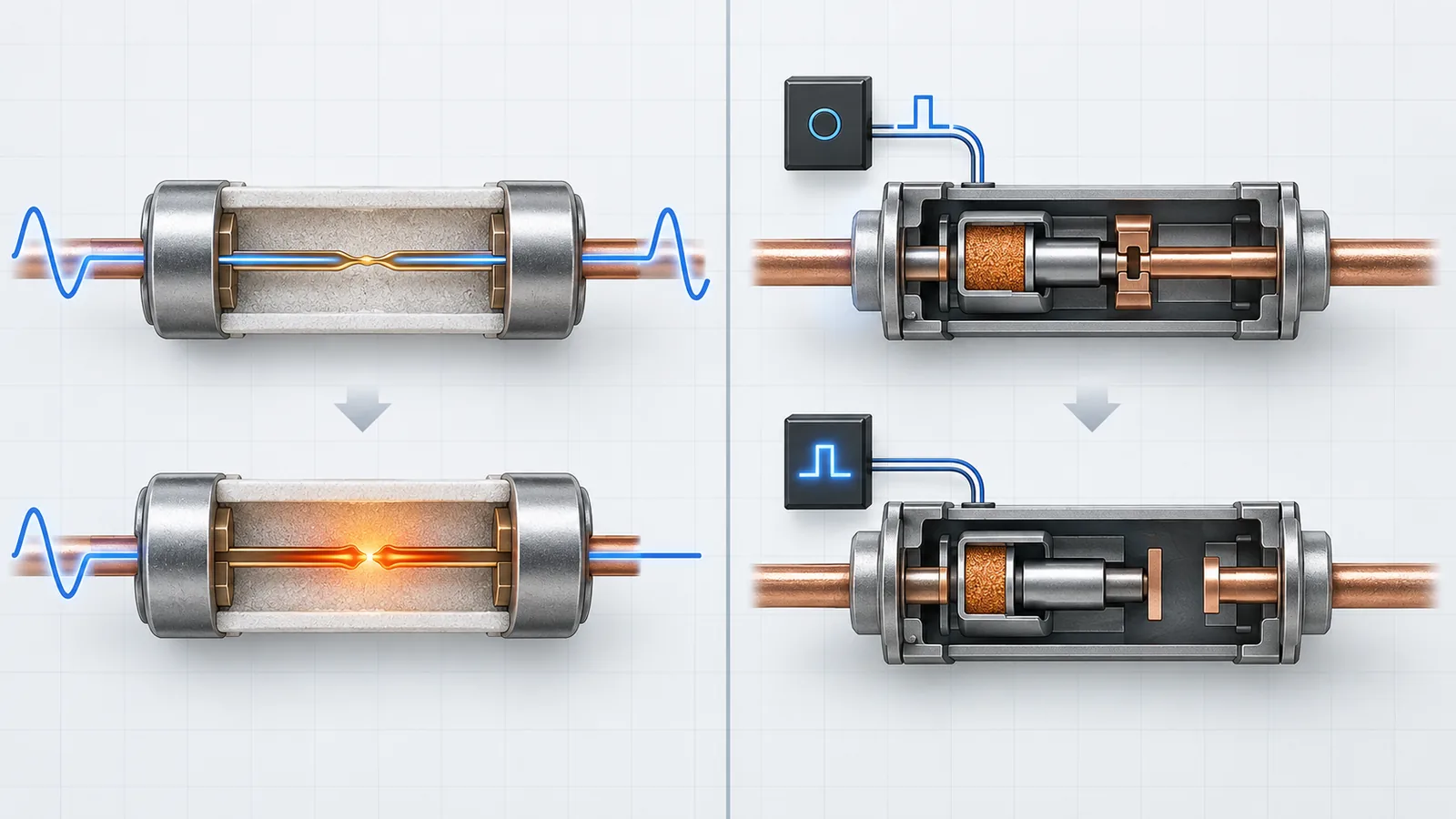
A conventional fuse opens when current-generated heating melts its element. A pyrofuse receives an external firing command and uses a pyrotechnic mechanism to separate the current path. Our introduction to how a pyrofuse works explains the triggered isolation principle.
| Selection question | Conventional current-operated fuse | Externally triggered pyrofuse |
|---|---|---|
| What initiates operation? | Heating caused by current through the element | A firing signal from an external controller |
| What determines system response? | The current waveform and fuse characteristic | Detection, decision, trigger delivery and device operation |
| Can it disconnect after a low-current crash event? | It may not melt if current remains below its operating threshold | It can be commanded to operate within its specified duty |
| Is it reusable after operation? | No | No |
| What must be validated? | Load endurance, fault interruption and protection coordination | Trigger circuit, diagnostics, interruption duty and control strategy |
These devices can serve complementary roles. A pyrofuse is not automatically a replacement for passive overcurrent protection. For system-level tradeoffs, read our fuse and pyrofuse comparison; for available triggered-disconnect options, explore Chauron’s pyrofuse products.
Which Applications Commonly Need Special Fuses?
Electric vehicles
Traction batteries combine high voltage with repeated acceleration, regeneration and charging pulses. Selection must account for contactor coordination, cable protection, thermal conditions and the vehicle’s crash-isolation architecture.
Energy storage systems
Battery racks and parallel strings can contribute to fault current from multiple paths. Evaluate battery-side and power-conversion-side faults, operating voltage and protection selectivity across the installation.
Charging infrastructure
Main DC paths, converter stages and auxiliary branches have different protection objectives. Match each fuse to the relevant circuit and component withstand limits. Chauron’s EV charging protection solutions provide application context for this discussion.
Solar and wind power
Renewable-energy systems combine converter protection with DC operating conditions and environmental exposure. PV string protection and inverter semiconductor protection should be evaluated as separate duties.
Data centers and UPS systems
Battery backup, DC distribution and dense power-conversion equipment require coordination, controlled temperature rise and careful use of installation space. For AI infrastructure specifically, see why AIDC needs special fuses.
What Information Should You Send to a Special Fuse Manufacturer?
A useful inquiry describes the application and the protection objective. Include the following information where available:
- Application and equipment type.
- Circuit diagram and fuse location.
- Maximum operating voltage and AC or DC operation.
- Continuous current.
- Overload and pulse waveforms.
- Maximum and minimum prospective fault currents.
- Circuit inductance, resistance or L/R time constant.
- Required clearing time and protection objective.
- Coordination and component withstand requirements.
- Temperature, cooling and other environmental conditions.
- Mechanical drawing and installation constraints.
- Required standards and approvals.
- Prototype quantity and estimated production volume.
- Validation and production timeline.
- Existing part number and documentation, if replacing a component.
Mark unknown values as open engineering questions. This gives the supplier a clearer basis for evaluating feasibility than an incomplete rating or photograph alone.
Common Special Fuse Selection Mistakes
Selecting only by amperage
Two fuses with the same current rating can have different operating curves, interruption capabilities and thermal behavior.
Treating AC and DC ratings as interchangeable
Use the manufacturer’s stated DC capability for DC applications. Do not derive it from the AC nameplate rating.
Ignoring repeated pulses
A pulse that the fuse survives once may still affect endurance when repeated over the equipment’s life. Supply the complete duty cycle.
Assuming the same package means the same protection
Matching dimensions do not establish electrical equivalence. Check the operating and interruption characteristics.
Quoting a maximum rating without its conditions
Voltage, fault current, time constant and installation conditions belong together. A rating outside its documented conditions is not a valid selection basis.
Assuming certification covers every variant
Check the exact model and scope before specifying an approval in procurement or equipment documentation.
Frequently Asked Questions About Special Fuses
Is “special fuse” an official classification?
By itself, the term does not define a standardized performance specification. Identify the actual fuse category, ratings, application duty and applicable standard.
Does a special fuse always require a custom design?
No. An application-specific catalog product may already meet the requirements. Customization is appropriate when a documented gap remains.
Can a manufacturer reproduce a fuse from a photograph?
A photograph can help identify construction, but it cannot establish operating curves, breaking capability or material requirements. Supply electrical data and drawings as well.
Is a pyrofuse the same as a conventional fuse?
No. A conventional fuse responds to current-generated heat; an externally triggered pyrofuse responds to a firing command. The complete protection architecture determines how each is used.
Which specification matters most?
No single number is sufficient. Voltage, current profile, fault conditions, clearing behavior, installation and environment must be compatible with the selected device.
Should the fuse be validated in the final equipment?
Yes. Application validation should address relevant temperature rise, current cycling, coordination and fault conditions. Component ratings alone do not describe every installation.
Discuss Your Special Fuse Requirement With Chauron
Start with your application data: voltage, continuous and pulse current, fault conditions, mounting dimensions and validation requirements. Chauron’s HVDC fuse and pyrofuse offerings address different protection needs in electric vehicles, energy storage, charging infrastructure and other DC power systems.
If an existing product does not fit your requirements, explore Chauron’s customized fuse solutions for an engineering discussion about electrical performance, structure and operating conditions.
Need help specifying a special fuse? Send your fuse requirements to Chauron, including your circuit details, drawing and expected quantity, to discuss product suitability and the next validation steps.