
A DC fuse is a one-time overcurrent protection device designed and tested to interrupt direct current at a stated voltage and fault duty. It protects cables, busbars, batteries, power converters and other equipment by melting a calibrated element when current exceeds its time-current limit, then controlling the arc that forms as the element separates.
That final step is what makes DC fuse selection demanding. Alternating current crosses zero every half-cycle, which helps an AC arc extinguish. Direct current has no natural zero crossing. A fuse used on DC must create enough arc voltage and dielectric separation to force the current to zero without allowing a sustained arc inside the device.
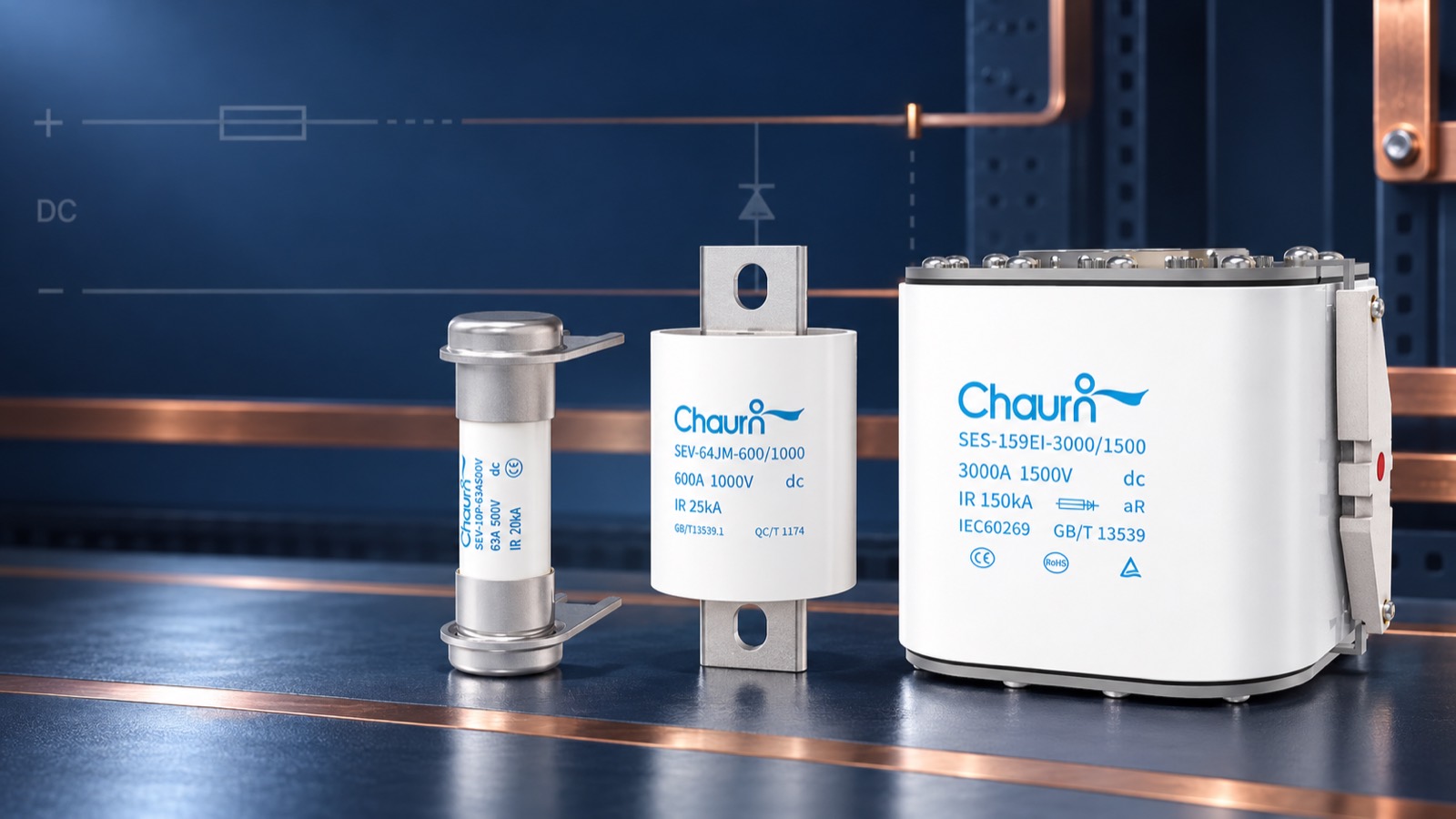
Chauron SEV and SES DC fuse products shown in a conceptual engineering composition. Confirm model-specific ratings before design-in.
How Does a DC Fuse Work?
A fuse element has a controlled electrical resistance and cross-section. Normal current heats the element, but the fuse remains within its thermal design limits. During an overload or short circuit, the rate of heating increases. When the element reaches its melting condition, it separates and an arc forms across the opening.
In a high-voltage DC fuse, the element geometry, ceramic body and arc-quenching filler divide, cool and lengthen that arc. The device must raise arc voltage above the circuit’s recovery voltage long enough to stop current safely. This interruption process explains why a fuse’s voltage rating, breaking capacity and tested circuit conditions matter just as much as its ampere rating.
The DC circuit time constant, expressed as L/R, affects breaking capacity, the time-current response and let-through current. Circuit inductance and resistance influence the magnetic energy that must be managed during interruption.
What Is the Difference Between a DC Fuse and an AC Fuse?
The two devices use the same basic principle—current heats a fusible element—but their interruption duties differ.
| Selection factor | DC fuse | AC fuse |
|---|---|---|
| Current zero | No periodic natural current zero | Current crosses zero every half-cycle |
| Arc extinction | Fuse construction must force current to zero | Natural zero crossing assists extinction |
| Voltage rating | Must be explicitly stated or validated for DC | Stated for the applicable AC frequency and duty |
| Fault-circuit parameter | Prospective current and L/R time constant are important | Prospective current and power factor are commonly specified |
| Substitution | Do not infer DC performance from an AC rating | Use only within the documented AC rating |
A higher AC voltage marking does not automatically create an equivalent DC rating. Use a fuse with documented DC performance at the system voltage and relevant fault conditions. If a datasheet does not state DC capability, ask the manufacturer rather than applying an informal conversion rule.
For a broader protection comparison, see Chauron’s guide to the difference between a fuse and a pyrofuse.
What Types of DC Fuses Are Available?
“DC fuse” describes the current type, not one universal package or protection class. The correct category depends on the circuit.
Low-voltage automotive fuses
Blade, cartridge and bolt-down fuses protect 12 V, 24 V and 48 V vehicle circuits. Package size alone does not establish compatibility; voltage, breaking capacity, time-current behavior and terminal conditions still need to match the circuit.
Battery and high-voltage DC fuses
Battery systems can deliver high short-circuit current even when their operating voltage appears modest. Electric vehicles and energy storage systems add high voltage, repeated load cycling and coordination requirements with contactors, busbars and power electronics. Chauron’s published high-voltage DC fuse range covers multiple EV, ESS and charging duties; use the individual product page and current datasheet for the final rating.
Semiconductor and high-speed fuses
Power semiconductors may be damaged before a general-purpose fuse clears a fault. High-speed fuses are designed to limit peak current and total clearing I²t. Selection requires coordination with the semiconductor’s short-circuit withstand data, not simply choosing the fastest curve available.
Photovoltaic DC fuses
PV string and array fuses are designed for photovoltaic operating voltage and reverse-current fault conditions. They may need to clear relatively low multiples of normal string current while also tolerating temperature and irradiance-related current variation.
Industrial and rail DC fuses
Industrial drives, UPS systems, rail equipment and DC distribution networks can impose different time constants, environmental conditions and mechanical requirements. Product standards and test conditions must match the intended duty.
Pyrofuses for commanded isolation
A pyrofuse receives an external trigger command and severs the current path using a pyrotechnic mechanism. It can isolate a battery after a crash or another detected event even when current has not reached a conventional fuse’s melting threshold. It is not an automatic replacement for passive overcurrent protection; many architectures coordinate both devices. Buyers comparing suppliers can also review the company’s pyrofuse manufacturer guide.
How Do You Select the Right DC Fuse?
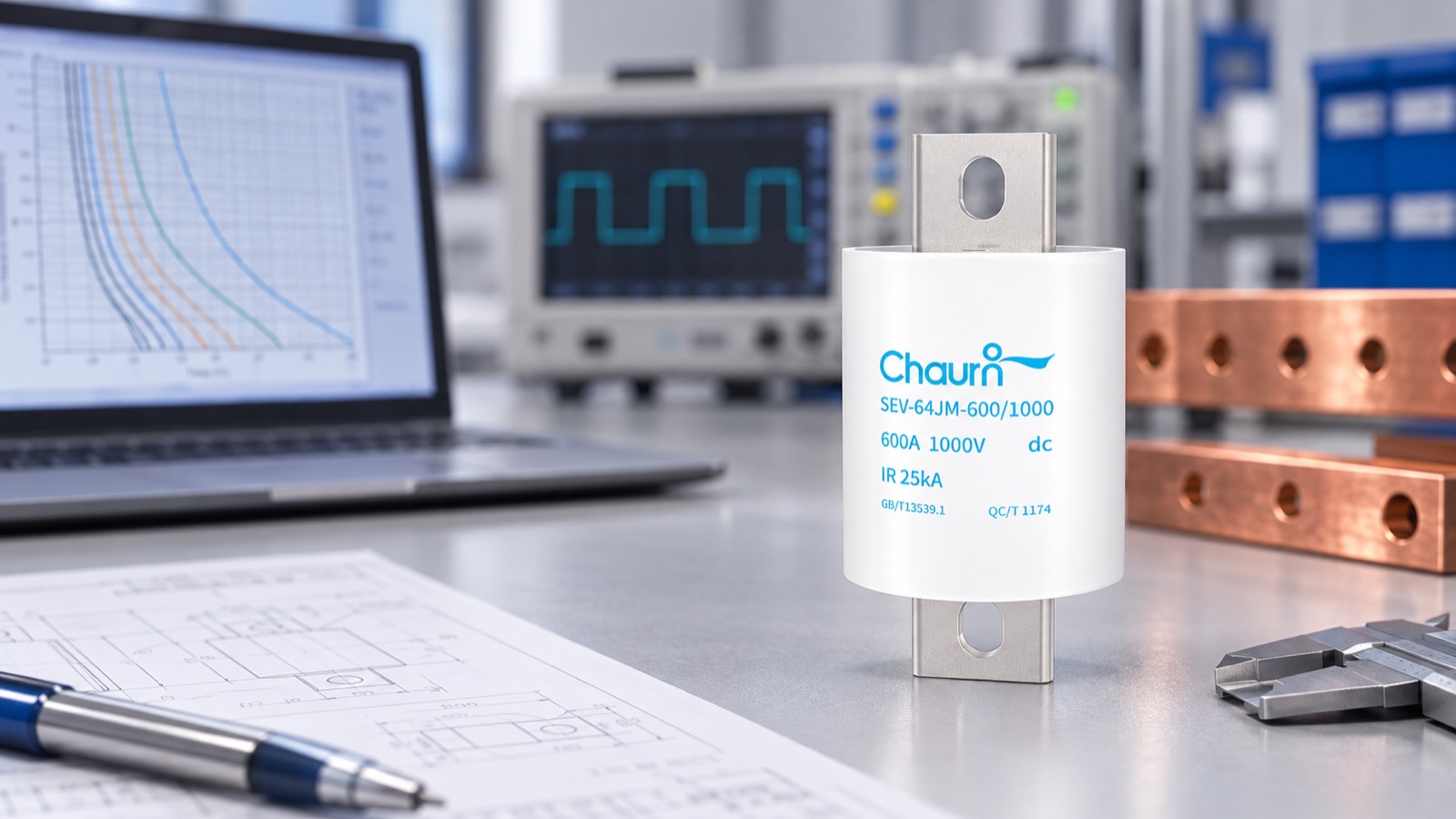
DC fuse selection requires circuit data, time-current coordination and the actual installation conditions.
1. Define the maximum DC voltage
Use the highest continuous system voltage, not merely the nominal battery or bus voltage. Include charging voltage and credible operating transients. The fuse’s documented DC rating must meet or exceed this value under the stated test conditions.
2. Describe the complete current profile
Record continuous current, expected overloads, inrush, acceleration or charging pulses, pulse duration and repetition. A fuse must carry every legitimate operating event without nuisance opening while still protecting the circuit during faults.
Ambient temperature, enclosure temperature, airflow, conductor size and terminal design affect heat dissipation. A current rating established under reference conditions may require application derating.
3. Calculate maximum and minimum prospective fault current
Breaking capacity must cover the maximum prospective current at the applicable DC voltage. The minimum fault current also matters, especially for partial-range or high-speed fuses that may not provide low-overload protection.
Evaluate applied DC voltage, circuit time constant, prospective short-circuit current and fuse pre-arcing I²t together. Validate the selected fuse under the actual application conditions.
4. Establish the L/R time constant
The DC time constant is inductance divided by resistance. It describes how quickly fault current rises and how much magnetic energy the interruption process must manage. Do not use a breaking-capacity value tested at one L/R condition as proof of performance at a more demanding condition.
If L and R are uncertain, provide a simulated or measured fault-current waveform to the fuse manufacturer. Battery state of charge, cable length, busbar geometry and converter components can change the effective fault path.
5. Compare time-current curves
Plot legitimate load events and protected-component withstand limits against the fuse curve. Check both low-level overloads and high-current faults. The fuse should remain closed during intended operation and open before cables, contactors, busbars or power semiconductors exceed their allowable stress.
Time-current coordination also determines selectivity. A downstream fault should ideally open the closest protective device without unnecessarily disconnecting a larger part of the system.
6. Check pre-arcing I²t, total clearing I²t and peak let-through
I²t is the integral of current squared over time, expressed in A²s. Pre-arcing I²t ends when the element melts; total clearing I²t also includes the arcing interval. For semiconductor protection, compare the applicable total clearing value and peak let-through current with the component’s withstand data under compatible voltage and fault conditions.
I²t is a coordination quantity, not a substitute for the full time-current curve or a universal energy value in joules.
7. Verify dimensions, terminals and mounting
Confirm body dimensions, terminal orientation, hole spacing, bolt size, tightening torque, creepage and clearance, mounting orientation and service access. A fuse that fits loosely or operates with excessive connection resistance can develop unacceptable temperature rise.
8. Confirm standards and exact approval scope
Check the application standard, equipment requirements and destination market. Approval of a product family does not automatically cover every current rating, terminal option or custom variant. Confirm voltage, interrupting current, operating range, terminal size and approval scope for the exact model selected.
DC Fuse Selection Example: An 800 V Battery System
Consider an 800 V nominal battery feeding an inverter through contactors and a main fuse. “800 V, 400 A fuse” is not enough information for a defensible choice. The engineering file should also contain:
- Maximum charged voltage and relevant transient voltage
- Continuous RMS current at the local enclosure temperature
- Acceleration, regeneration and fast-charging pulse profiles
- Maximum and minimum fault currents across battery states of charge
- Estimated L/R time constant or fault-current waveform
- Cable, busbar, contactor and inverter withstand limits
- Required clearing times and coordination objectives
- Terminal geometry, torque, vibration and service-life requirements
Only after these inputs are known should the designer compare product curves and model-specific test data. Chauron’s existing guide to special fuse requirements covers cases where a catalog fuse cannot meet the combined electrical, mechanical or environmental specification.
Where Are DC Fuses Used?
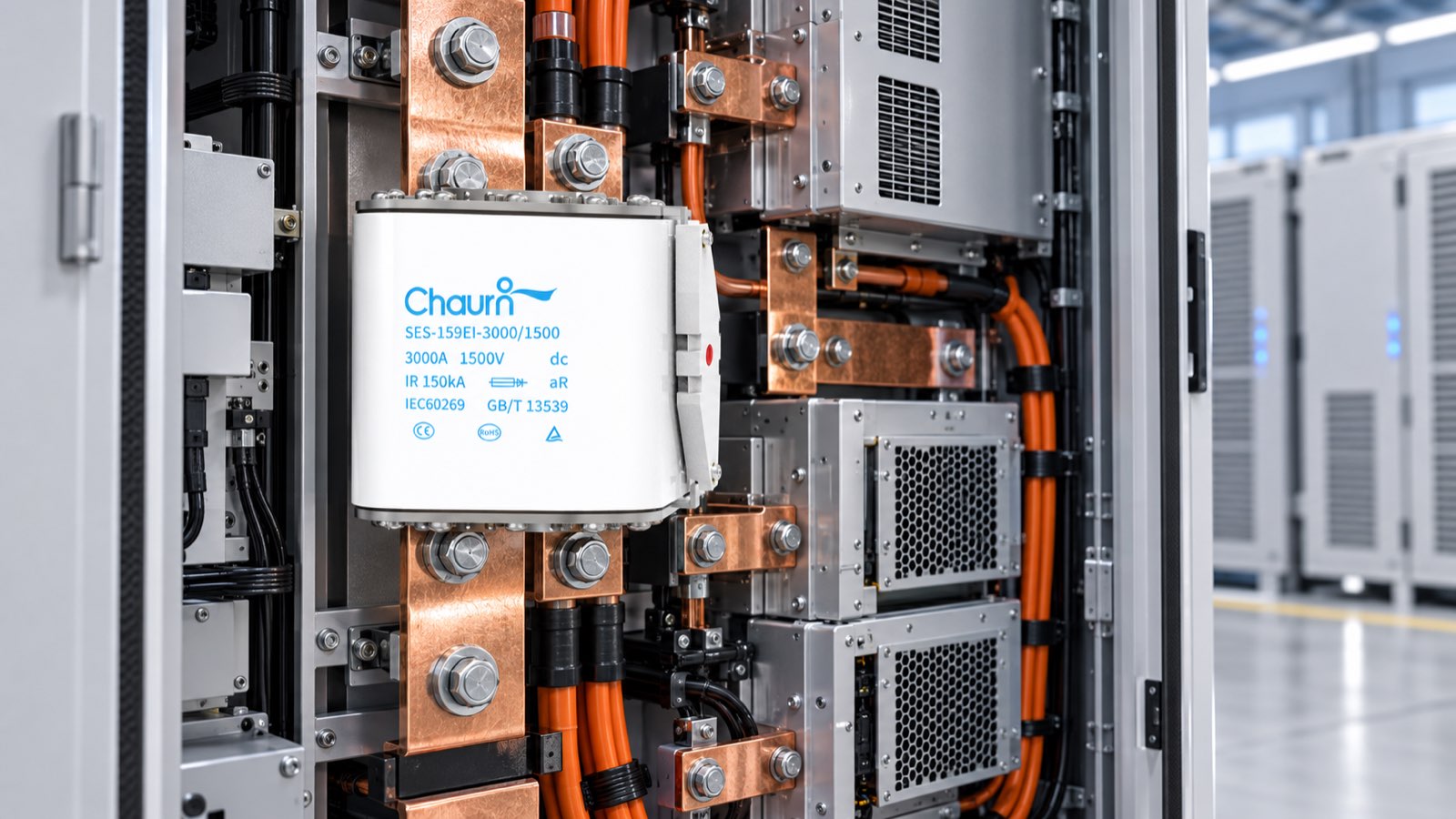
Conceptual application scene based on the Chauron SES-159EI product; the final installation must follow model and system documentation.
Electric vehicles
DC fuses protect traction batteries, battery disconnect units, power distribution units, inverters, onboard chargers, DC/DC converters and high-voltage auxiliaries. Normal acceleration, regenerative braking and fast charging make pulse endurance important. Explore Chauron’s EV fuse and high-voltage protection solutions for the broader product and application context.
Battery energy storage systems
ESS protection can be required at cell-module, rack, combiner, PCS and container levels. Parallel strings introduce multiple sources of fault contribution. The fuse at each level must coordinate with conductors and switching devices while preserving useful selectivity.
DC fast charging
Charging cabinets contain main DC paths, converter modules and auxiliary branches with different fault duties. Selection must consider DC bus voltage, available current, semiconductor protection and thermal conditions. Chauron’s EV charging pile fuse solutions provide application-specific context.
Solar, wind and industrial conversion
PV strings, battery-coupled solar systems, wind converters, industrial drives and UPS equipment all use DC protection, but they do not necessarily use the same fuse class. Match the product to the source characteristics, converter topology and applicable standard.
AI data centers
High-density data centers may use battery backup, UPS equipment, DC buses and power-conversion stages with high fault energy and strict availability requirements. Read why AIDC systems need special fuses for selective isolation, semiconductor coordination and high-voltage DC interruption.
Common DC Fuse Selection Mistakes
Choosing only by ampere rating. Two 400 A fuses can have different voltage ratings, operating curves, breaking duties and thermal performance.
Using an AC fuse because it physically fits. Mechanical compatibility does not prove DC interruption capability.
Ignoring low-current faults. A fuse with a high maximum breaking capacity may still require separate overload protection below its minimum breaking current.
Using one temperature for the whole system. The fuse’s local enclosure and terminal temperature may be much higher than room temperature.
Reading a time-current curve without checking L/R. DC fault-current rise and interruption depend on circuit inductance and resistance.
Treating a pyrofuse as a drop-in replacement. Trigger logic, diagnostics and commanded isolation solve a different part of the protection problem.
Frequently Asked Questions About DC Fuses
Can a DC fuse be used in an AC circuit?
Only if the manufacturer documents the applicable AC rating and test conditions. Do not assume interchangeability from package size or a DC marking alone.
Can an AC fuse be used in a DC circuit?
Use it only when the manufacturer explicitly specifies or validates its DC capability for the relevant voltage, fault current and time constant. An AC voltage rating by itself is insufficient.
Should a DC fuse be installed on the positive or negative conductor?
Placement depends on grounding, isolation monitoring, fault paths and the equipment protection architecture. Some systems require protection on one pole; others use protection or switching on both. Follow the system design and applicable standard.
How much larger than the normal current should the fuse rating be?
There is no universal percentage. The margin depends on the load waveform, ambient temperature, conductor cooling, pulse count, required life and the manufacturer’s derating guidance.
Does a higher voltage rating make a DC fuse safer?
A sufficient DC voltage rating is essential, but it does not prove that the current rating, operating curve, breaking capacity, I²t or mechanical interface is correct. All selection parameters must be evaluated together.
Is a DC breaker better than a DC fuse?
They serve different design goals. A fuse can provide fast current limitation and high interruption capability without a control power source. A breaker may offer resettable isolation and switching functions. Many systems coordinate both rather than choosing one universally.
Find a DC Fuse for Your Application
Chauron publishes high-voltage DC fuse products for electric vehicles, energy storage, charging infrastructure and other high-energy DC systems. The current catalog spans multiple voltage, current and breaking-duty ranges; every selection should be confirmed against the exact model data and the complete application profile.
Start with the Chauron HVDC fuse catalog. If you need help matching voltage, load cycles, fault current, L/R, I²t and mounting constraints, send your DC fuse requirements to Chauron for model selection or a customized engineering discussion.