
A PV fuse protects photovoltaic circuits against damaging overcurrent. In an array with parallel strings, it can interrupt reverse current flowing from healthy strings into a faulty one. Selection depends on the array’s maximum DC voltage, normal current and fault conditions, together with the limits of the modules and wiring.
Choosing the amp rating takes more than reading the panel label. The fuse needs to carry normal generation current through daily temperature changes and clear faults before the protected equipment is damaged.
I. What Is a PV Fuse?
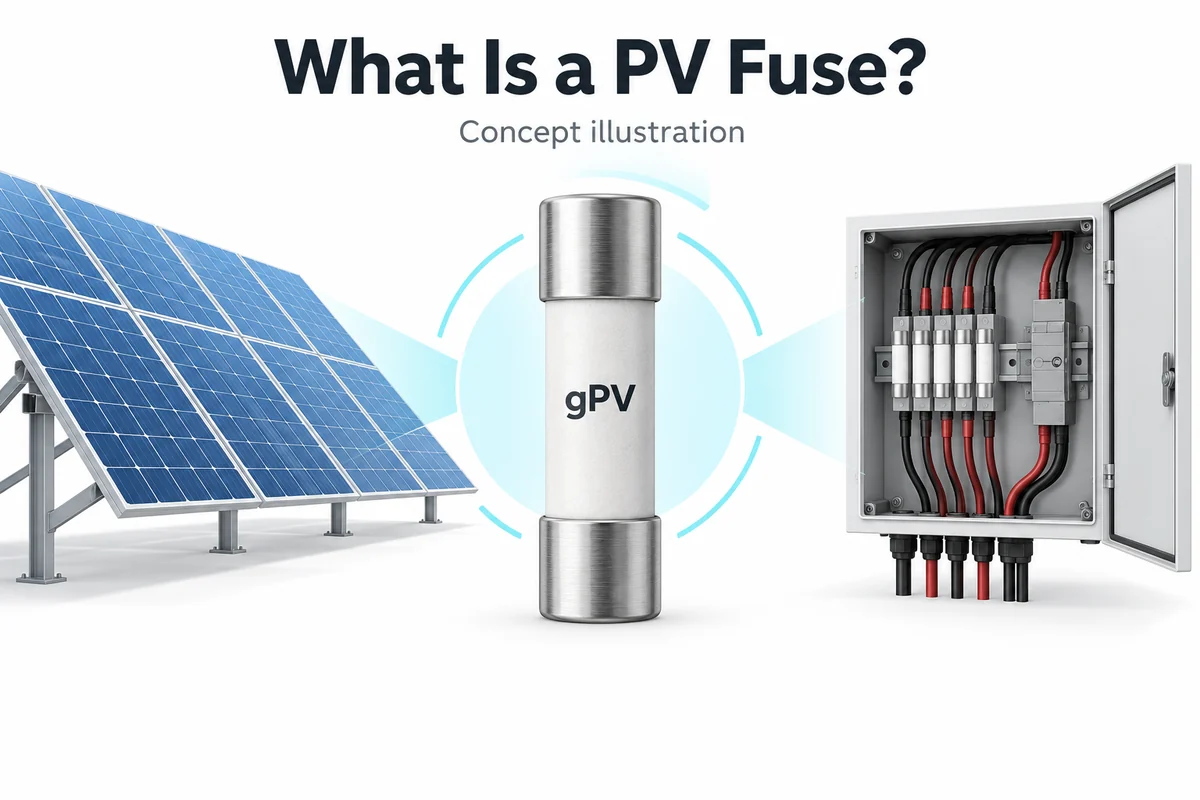
A photovoltaic fuse, also called a solar fuse or solar string fuse, contains a fusible element that opens when current exceeds its time-current characteristic. The assembly must then extinguish the DC arc and withstand the voltage across the opened circuit. Unlike AC, DC has no periodic natural current zero to help interrupt an arc.
Some PV faults produce only a modest overcurrent. Check the time-current curve at those lower currents as well as the maximum breaking capacity. Daily generation cycles and the temperature inside the enclosure also affect selection.
II. What Does gPV Mean?
gPV identifies a full-range fuse characteristic for photovoltaic applications, covering the specified overload and short-circuit operating range. Clearing time depends on the fault current and the manufacturer’s curve. The marking does not promise instantaneous protection against every fault.
IEC 60269-6 specifies additional requirements for fuse-links protecting PV strings and arrays in circuits up to 1,500 V DC within the published standard’s scope. For projects requiring North American approvals, verify the exact product listing and applicable PV fuse requirements, rather than treating an IEC marking as an automatic substitute.
A ceramic cartridge or bolt-down body tells you how a fuse is constructed or mounted. Look at its application rating and documentation to establish whether it is suitable for PV service.
III. Why Parallel PV Strings Need Protection
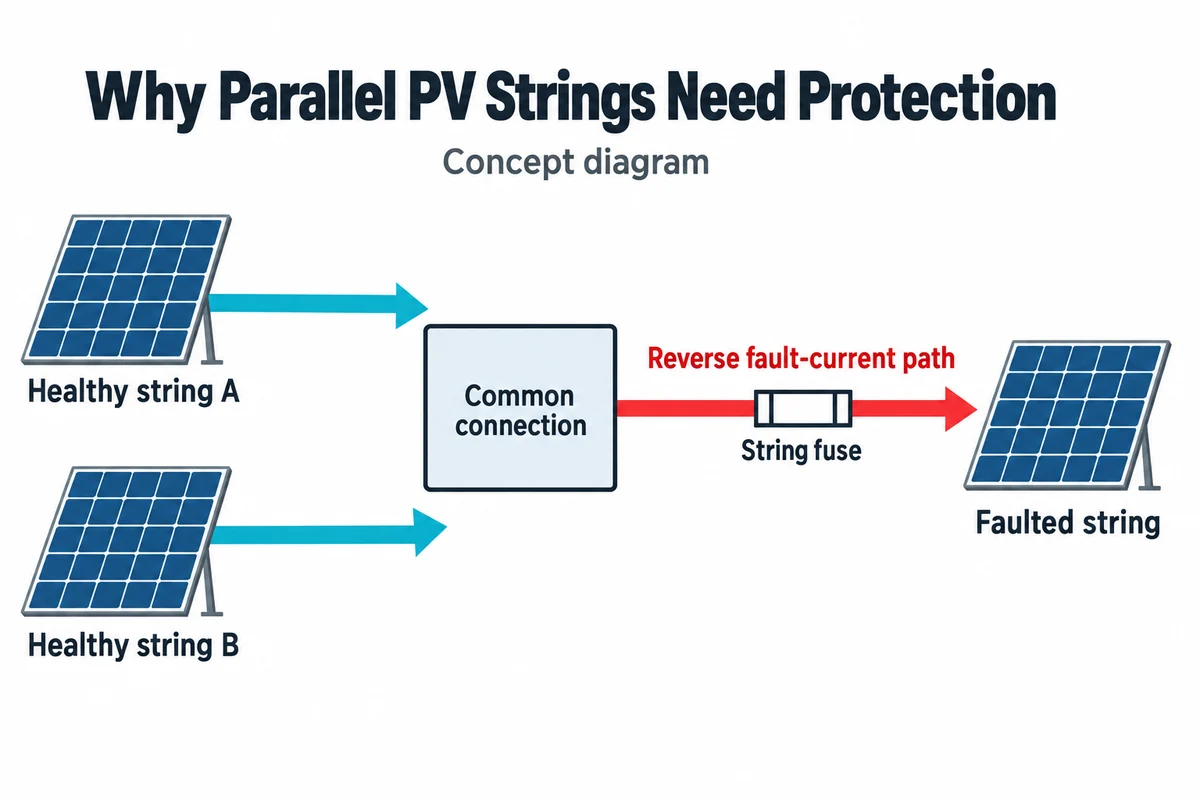
A faulted string can receive current from healthy strings connected to the same DC collection point. That reverse-current contribution may exceed what the affected modules or wiring can withstand, even though each healthy string produces only its normal available current.
Start by identifying the strings that share a connection and the current each can feed into a fault. Check other possible sources too. In a solar-storage system, the inverter’s conversion and isolation arrangement determines whether the battery can contribute; a battery connection alone does not establish a direct fault path.
Use that fault assessment, the module and cable limits, equipment instructions and local installation requirements to decide where fuses are needed. Neither the panel count nor a general rule about parallel strings replaces this check.
IV. Where Are PV Fuses Used?
String branches and combined outputs carry different currents. They often need different fuse ratings and may use different mounting arrangements.
| Location | Protection duty to assess | Selection concern |
|---|---|---|
| Individual string or approved in-line assembly | Reverse-current exposure of modules and string conductors | Module limit, string current and environmental sealing |
| Combiner-box inputs | Individual string branches joining a common connection | Holder compatibility and enclosure temperature |
| Subarray or recombiner output | Combined circuits and associated cables | Higher operating current and coordination with upstream branches |
| Inverter-related DC circuits | The specific input or internal circuit | Equipment instructions; semiconductor protection may require a different fuse class |
For a project covering the array and power-conversion equipment, review Chauron’s solar power circuit protection solutions. Specify which circuit each fuse will protect so that the proposed device can be checked against that duty.
V. How to Select a PV Fuse
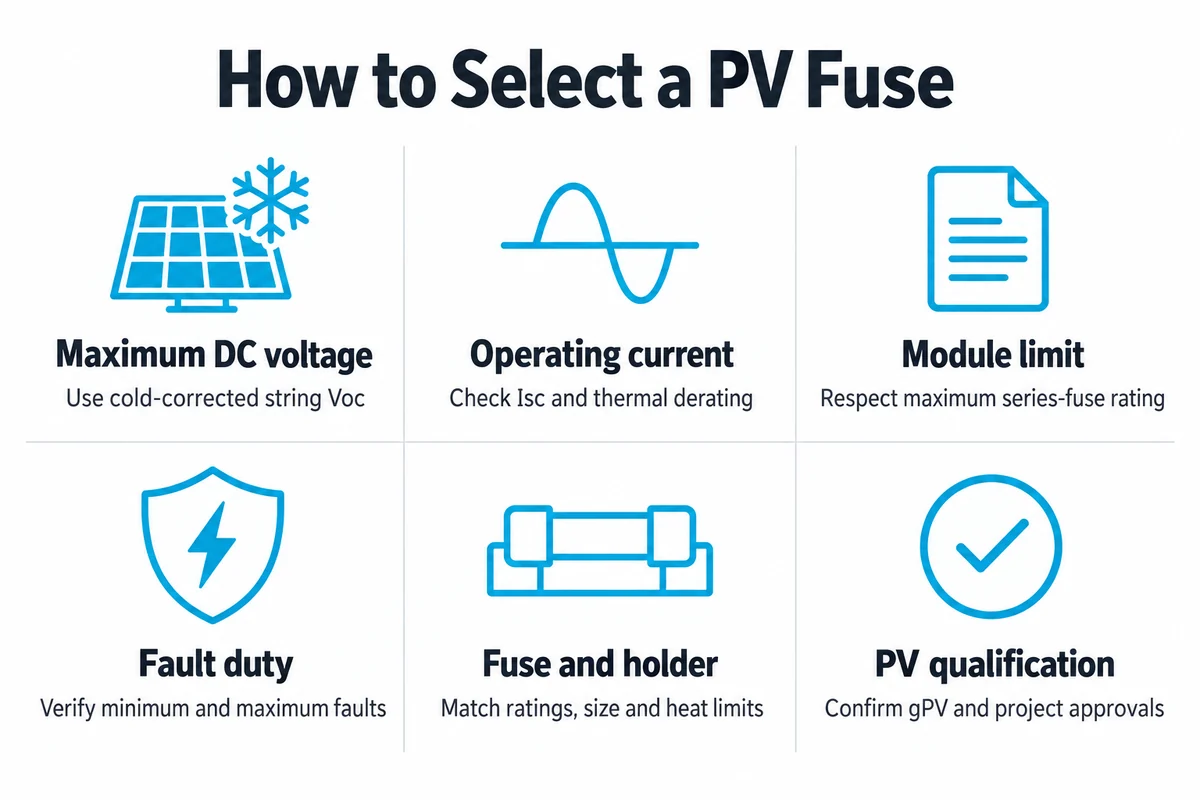
Start with maximum DC voltage
Use the maximum calculated string open-circuit voltage, including the required cold-temperature correction. Normal operating voltage at the inverter’s maximum power point is not the appropriate upper limit. Confirm the DC voltage rating of both the fuse and its holder.
Consider a hypothetical string of 20 modules, each with a reference open-circuit voltage of 49 V. That gives 980 V. With an assumed, project-approved cold correction of 1.12, the value rises to 1,097.6 V, exceeding a 1,000 V fuse’s rating. Use the actual module data and required correction method for your project.
Find a permissible current rating
Begin with module short-circuit current, string arrangement and the current calculation required for the project. Account for relevant irradiance and bifacial conditions where applicable. Then apply the fuse manufacturer’s thermal and installation guidance.
The selected rating must stay within the protection limits of the modules, cables and equipment. Treat the module’s maximum series-fuse rating as an upper limit. It is not a recommended size for every installation. If carrying the required current would exceed that limit, the design needs review.
Check the complete fault range
Compare the highest prospective fault current with the fuse’s breaking capacity at the relevant DC voltage and test conditions. Then check clearing time at the lower faults the circuit can produce. Passing the maximum-current check does not establish adequate protection at those lower currents.
Match the holder and installation
Cylindrical, in-line and larger blade or bolted formats serve different installations. Mechanical fit alone is insufficient: verify DC voltage, current capability, power-loss acceptance, terminal requirements and the approved fuse combination. Outdoor assemblies need suitable environmental protection as well.
Keep a record of the sizing method and correction factors used. Apply them with the equipment data and installation requirements for the project; a current multiplier taken from another design may not apply.
VI. PV Fuse vs. General DC Fuse
A general DC fuse may have sufficient voltage capability but a different operating characteristic. PV string protection also requires suitable low-overcurrent response, cycling performance and application qualification.
| Device description | What it establishes | What still needs verification |
|---|---|---|
| PV fuse with documented gPV characteristic | Application-specific photovoltaic protection characteristic | Voltage, current, clearing performance, installation and project approval |
| General DC fuse | Documented direct-current duty within its ratings | Suitability for PV string faults and the required PV qualification |
| AC-only fuse | Its stated alternating-current duty | It must not be assumed suitable for a DC circuit |
When reviewing Chauron’s high-voltage DC fuses for other circuits in the installation, request the exact model’s application data. Do not infer gPV qualification from a catalog voltage rating.
Solar-storage projects may also require a commanded battery disconnect. Chauron’s Pyrofuse products address that separate function. Their triggering interface and interruption duty need their own review; they should not be treated as drop-in replacements for PV string fuses.
VII. Common PV Fuse Mistakes
If a fuse opens repeatedly, investigate the fault history, operating current and enclosure temperature before changing its rating. Check the terminals as well: a loose or degraded connection can produce local heat without enough overcurrent to operate the fuse.
Some ground faults and series-arcing conditions need separate detection and protection. An open fuse also leaves illuminated PV modules capable of producing voltage.
Only qualified personnel should service the equipment, following its isolation procedure. A fuse holder must not be opened under load unless it is specifically designed and rated for that operation.
VIII. Frequently Asked Questions
Does every solar panel need a fuse?
No universal per-panel rule applies. Assess the circuit arrangement, available reverse current, module and cable limits, and equipment instructions. Protection is often considered at string or combined-circuit level. The number of panels alone does not determine whether a particular fuse arrangement is required.
Can I use a 1,500 V PV fuse on a 1,000 V system?
A higher voltage rating may satisfy the voltage check, but it does not establish overall suitability. Current rating, operating curve, holder compatibility and product approvals must also match. Never assume a physically different fuse can be fitted to the existing holder.
Is a PV fuse the same as a battery fuse?
No. Photovoltaic strings and batteries have different source and fault characteristics. Battery fuses need to suit the battery circuit’s operating and fault duty. A product may be approved for both applications, but that approval must be documented; matching voltage and ampere markings is insufficient.
Should a PV fuse go on the positive or negative conductor?
The grounding arrangement, fault paths and applicable installation requirements determine the protection layout. Some designs require protection on both poles. Follow the approved system design rather than transferring a rule from an unrelated battery or automotive circuit.
Can a circuit breaker replace a PV fuse?
Only when the breaker is suitable for the PV application and satisfies the required DC voltage, interruption duty, operating response and equipment requirements. Reset capability does not establish equivalent protection. Any substitution needs a coordination and compliance review.
What should I send a supplier for PV fuse selection?
Provide the module datasheet, series and parallel string counts, minimum design temperature, maximum series-fuse rating, cable details, enclosure conditions and required approvals. Include the inverter configuration and any other possible fault sources. Identify whether the request concerns a string, combiner output or another circuit.
IX. Discuss Your Solar Protection Requirements with Chauron
For a solar or solar-storage project, Chauron can review your protection requirements. Include the circuit diagram, module data and operating conditions in your fuse selection inquiry. State when gPV qualification is required and ask for the proposed model’s supporting documentation before design approval.