
High rupturing capacity (HRC) describes a fuse’s ability to safely interrupt a large prospective fault current under specified electrical conditions. It concerns fault interruption, rather than normal load current. An HRC fuse must be selected using its voltage rating, AC or DC duty, breaking capacity and operating characteristics together.
For an equipment designer or buyer, the useful question is: can this exact fuse clear the faults that this circuit can produce? A high number on a catalogue page is only part of the answer.
What does high rupturing capacity mean?
Rupturing capacity, breaking capacity and interrupting rating describe the fault current a protective device can safely interrupt under its stated conditions. HRC means high rupturing capacity; HBC means high breaking capacity. These labels often describe the same practical capability, but neither identifies a complete, interchangeable fuse specification.
A fuse can melt and still fail to interrupt safely if an arc continues inside it. The body, filling material and element design therefore matter as much as the element’s ability to melt.
This guide focuses on low-voltage industrial and DC applications, where the fuse must be evaluated against both normal operating conditions and the available fault current.
Current rating vs breaking capacity: read both numbers
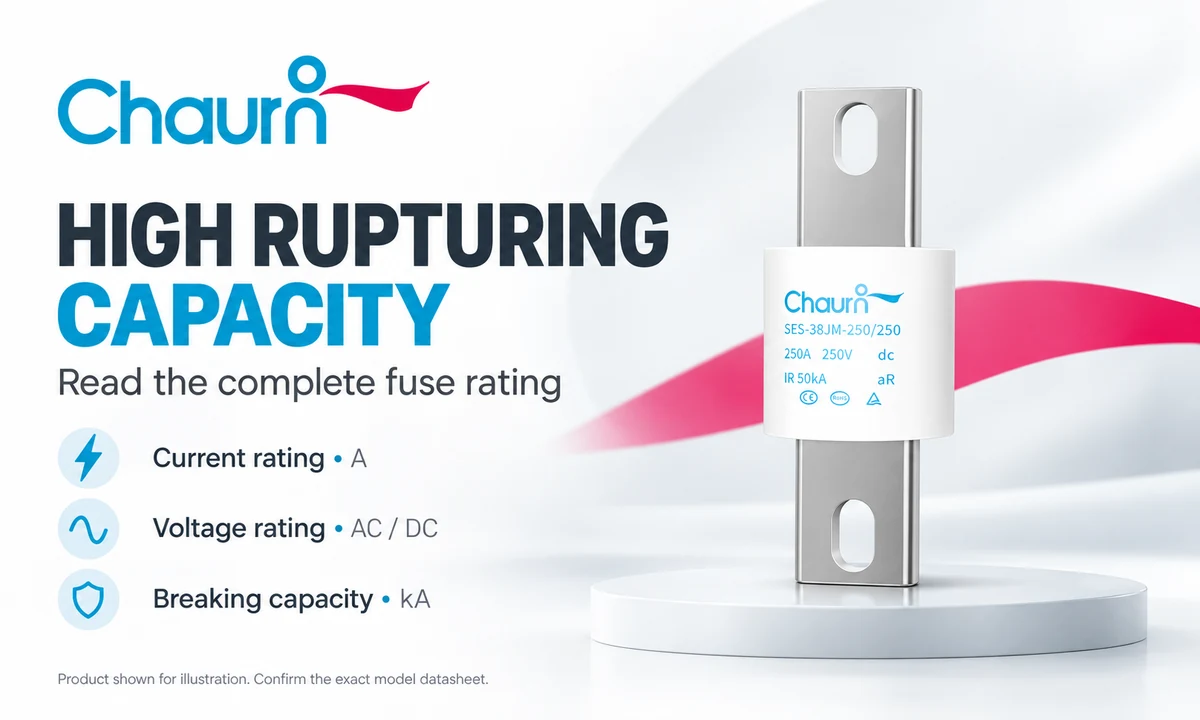
The current rating describes carrying duty; breaking capacity describes fault-interruption duty. They answer different questions, even though both are expressed in amperes.
| Specification | What it tells you | What it does not tell you |
|---|---|---|
| Rated current, A | Current the fuse is designed to carry under specified conditions | The maximum fault current it can safely interrupt |
| Rated voltage, V AC or V DC | The voltage duty for which interruption is rated | Whether an AC-only fuse is suitable for DC |
| Breaking capacity, kA | The maximum prospective fault current it can interrupt under stated conditions | Its opening time at a particular overload |
| Time-current curve | How melting or clearing time varies with current | Complete protection coordination without checking tolerances and other devices |
For example, a hypothetical 100 A fuse with an 80 kA AC breaking capacity does not wait for 80,000 A before operating. It may open at much smaller overcurrents, with the operating time determined by its curve. The 80 kA figure describes its upper fault-interruption capability at the specified AC voltage and test conditions.
The basic screening rule is:
Fuse breaking capacity ≥ maximum prospective short-circuit current at the installation point.
Apply that comparison at the required voltage and current type, using the exact model’s published ratings.
How does an HRC fuse interrupt a fault?
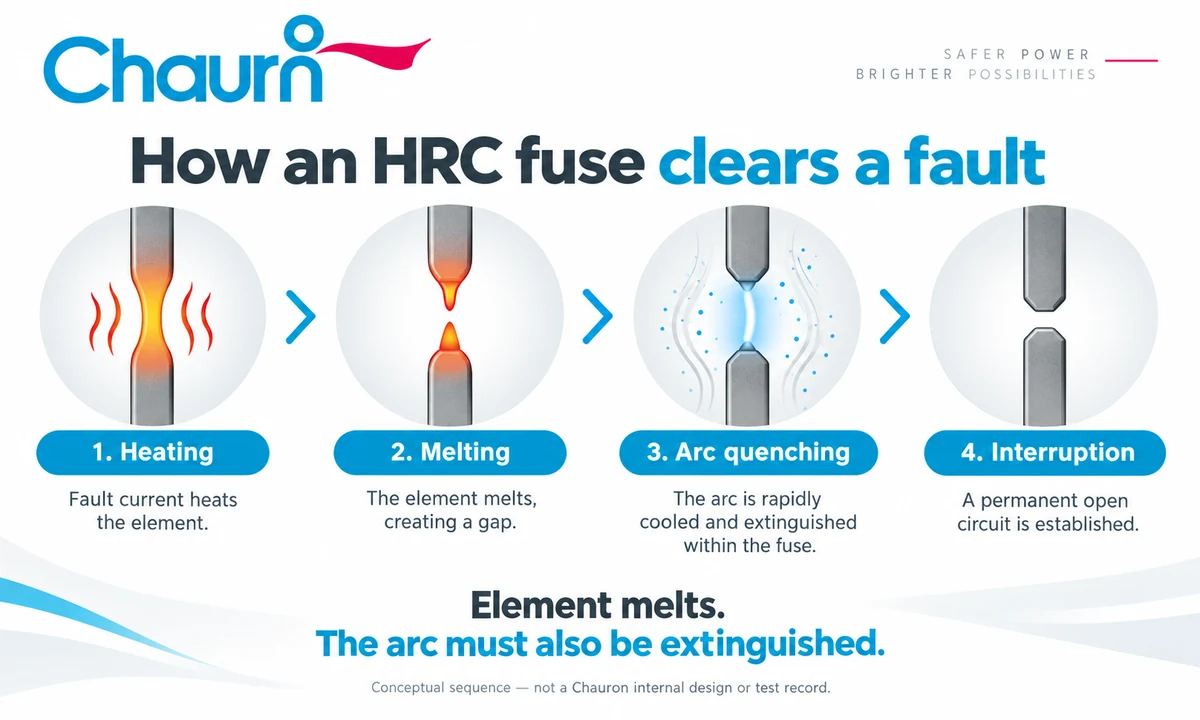
A typical industrial HRC cartridge contains a calibrated metal element inside an insulating body, commonly with a quartz-based filling. During a severe overcurrent, the element heats and melts at designed sections. Arcs form across the gaps; the filling and enclosure help manage their heat and extinguish them. The fuse-link then remains open and must be replaced.
A current-limiting fuse can also reduce the peak current that passes through the circuit during a sufficiently large fault. This behavior applies within its current-limiting operating range; it should not be interpreted as a promise of identical clearing speed at every overload.
Three pieces of manufacturer data help describe the resulting stress: peak let-through current, pre-arcing I²t and total clearing I²t. Pre-arcing I²t covers the period before the element melts; total clearing I²t also includes the arcing period. I²t has units of A²s and is a thermal-stress measure, rather than an energy value in joules by itself.
Compare values under compatible conditions, and use total clearing data when assessing the complete interruption event.
HRC is not an application category
Two fuses with high breaking capacities can serve different protection duties. The utilization category identifies the application and breaking range; the physical format identifies the mounting system.
| Category | Typical protection duty | Selection point |
|---|---|---|
| gG | Full-range general-purpose protection, commonly cables and distribution circuits | Coordinate with conductor capacity and load characteristics |
| aM | Partial-range motor short-circuit protection | Requires separate overload protection |
| aR | Partial-range semiconductor protection | Check minimum breaking current and semiconductor coordination |
| gR | Full-range semiconductor protection | Verify clearing characteristics against the protected equipment |
Partial-range fuses must not be expected to clear every possible low overcurrent safely without coordinated protection.
NH, cylindrical and bolted-tag formats describe construction and mounting arrangements, not a universal operating curve. A replacement that fits the holder still needs the correct electrical characteristics.
IEC 60269-1:2024 covers enclosed current-limiting fuse-links within its stated low-voltage scope. Its applicability does not establish that a particular product is certified or appropriate for every application. Request the exact model’s applicable standard and supporting documentation.
Can an AC HRC fuse be used in a DC circuit?
Only when the manufacturer provides a suitable DC rating for the required duty. A large AC breaking-capacity figure cannot be carried across to a battery or DC bus circuit.
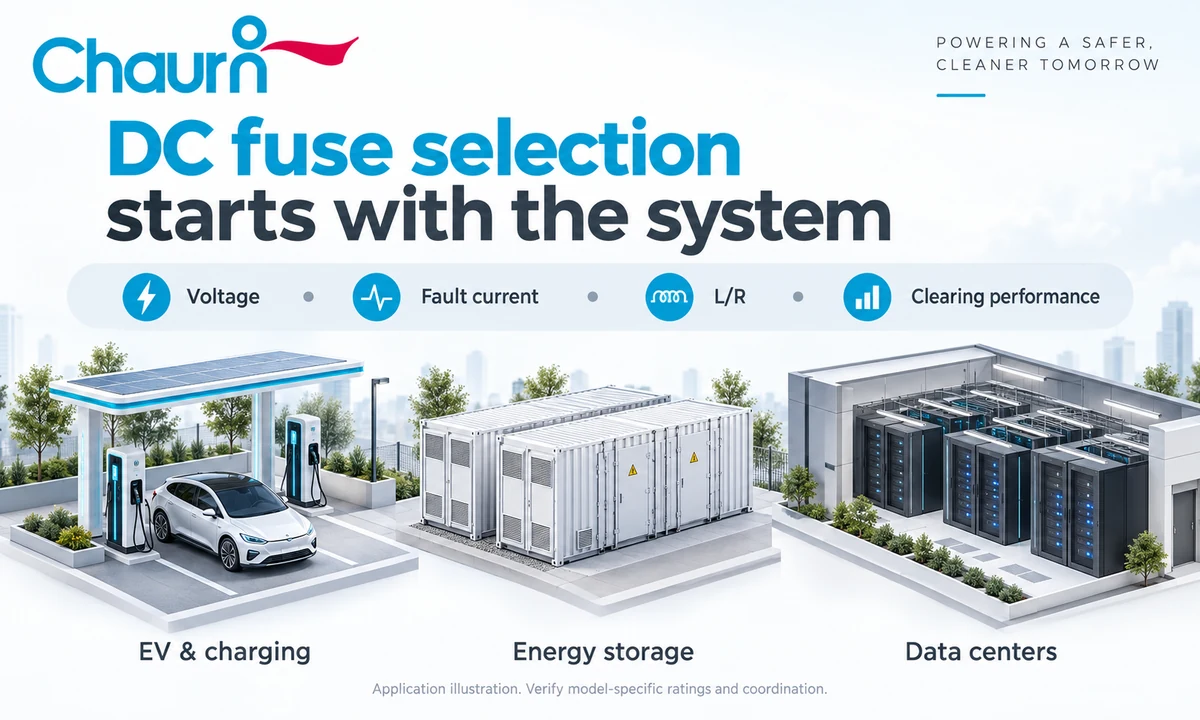
DC lacks the periodic natural current zeros of AC. Circuit inductance also affects interruption: the time constant L/R describes the relationship between inductance and resistance in the relevant circuit model. A DC rating should therefore be read alongside the manufacturer’s voltage, fault-current and time-constant conditions.
A concrete example is Eaton’s 250FM fuse. Its published data lists 200 kA RMS symmetrical interrupting capability for AC, while the IEC DC entry is 40 kA at 450 VDC. Those are different duties for the same product, not equivalent values. See the manufacturer’s 250FM specifications.
For a battery project, begin with maximum pack voltage and the prospective fault-current profile, then check the exact fuse variant. Chauron’s HVDC fuse range provides a starting point for model comparisons.
If the protection architecture also includes commanded disconnection, first understand how a pyrofuse works, then review the difference between a fuse and a pyrofuse. Triggering method and fault-interruption capability are separate selection questions; the devices should be evaluated within the complete protection scheme.
A practical HRC fuse selection example
Consider an illustrative DC circuit with a maximum operating voltage of 800 VDC and a calculated prospective fault current of 25 kA. The following is a specification-screening exercise, not a recommendation for a real installation.
| Hypothetical candidate | Initial assessment | Reason |
|---|---|---|
| 690 VAC, 100 kA AC; no DC rating | Insufficient evidence | The AC rating does not establish suitability at 800 VDC |
| 1000 VDC, 20 kA DC | Reject for the stated fault duty | 20 kA is below the circuit’s 25 kA prospective fault current |
| 1000 VDC, 50 kA DC | Continue engineering review | Voltage and maximum fault-current screening pass; other checks remain |
The third candidate still needs the correct current rating, permitted L/R, minimum breaking current, thermal derating, time-current performance and mounting arrangement. A satisfactory maximum interrupting rating alone cannot establish complete protection.
For a related application discussion, see why AI data centers need application-specific fuses. The same screening discipline applies: assess the actual distribution voltage and fault profile rather than transferring a fuse choice from another circuit.
Also distinguish the fuse’s interrupting rating from the equipment assembly’s short-circuit current rating (SCCR). A high-rated fuse does not automatically confer that rating on the whole panel. Check the assembly evaluation and any permitted device combinations.
What to include in an HRC fuse inquiry
Turn “we need an HRC fuse” into a reviewable requirement. An inquiry sheet should contain the following information:
- Circuit: application, maximum voltage, AC frequency or DC duty, and protection location.
- Load: continuous current, startup or pulse profile, duty cycle and anticipated overloads.
- Faults: maximum prospective fault current, lower-current faults requiring interruption, and DC L/R where applicable.
- Protection target: cable, battery, converter or other equipment, with damage limits and required clearing times.
- Installation: ambient temperature, cooling, enclosure, terminals, holder and available space.
- Evidence: applicable standard, exact part number, curves, let-through data and model-specific approvals.
For pulse and inrush duty, evaluate repeated events as well as a single pulse. Pulse shape, thermal cycling and application testing all matter when assessing long-term performance.
If a standard part cannot meet the combined electrical and mechanical requirements, document the unmet conditions before discussing a custom solution.
Frequently asked questions
Does a higher current rating mean higher rupturing capacity?
No. Current rating and breaking capacity are separate specifications. A higher-ampere fuse is not automatically capable of interrupting a larger fault. Replacing a fuse with a higher current rating can also change protection performance. Compare the complete datasheets rather than assuming the larger current number is safer.
Are HRC and HBC fuses the same?
The terms commonly express the same high fault-interruption capability. They do not guarantee that two products are interchangeable. Confirm voltage, current type, breaking capacity, utilization category, operating curve and mounting details for the exact replacement.
Is every HRC fuse fast acting?
No. HRC describes interruption capability rather than one universal speed. A fuse can tolerate an intended startup event yet limit a severe short circuit. Use its time-current curve and current-limiting data to establish how it behaves at the currents relevant to the application.
Does an HRC fuse provide overload protection?
That depends on its utilization category and coordination. Full-range and partial-range fuses have different breaking ranges. For example, an aM motor fuse requires separate overload protection. Check the manufacturer’s specified range rather than treating the HRC label as an overload-protection guarantee.
Can the same HRC fuse protect both AC and DC equipment?
Some products have both ratings, but the permitted voltages and interrupting capacities may differ substantially. Use the published rating for the actual circuit, including DC time-constant limits where specified. An AC marking alone is insufficient evidence for a DC application.
What documents should a supplier provide?
Request the exact part-number datasheet, dimensions, voltage and breaking-capacity conditions, time-current curves, relevant I²t data and applicable approval documents. For a demanding DC application, also request minimum breaking-current information and confirmation that the proposed fuse covers the circuit’s fault profile.
Discuss your DC protection requirements with Chauron
For EV, energy-storage or charging equipment, share your maximum DC voltage, load profile, prospective fault current, L/R and installation constraints with Chauron’s fuse selection team. These details support a meaningful comparison of candidate models and identify which performance data still needs confirmation.