
JCASE fuses and high-voltage DC (HVDC) fuses protect different parts of a vehicle. A JCASE fuse is normally used in 12V or 48V auxiliary circuits, while an automotive HVDC fuse protects traction batteries, inverters, chargers and other high-energy DC equipment. They differ in voltage rating, breaking capacity, construction, mounting and validation, so they are not interchangeable.
Quick answer: Choose a JCASE fuse for a compatible low-voltage vehicle fuse box and auxiliary load. Choose a validated HVDC fuse for a traction battery, BDU/PDU, inverter, DC fast charger or energy-storage system. Never substitute one for the other based only on ampere rating or physical size.
JCASE Fuse vs HVDC Fuse: Key Differences
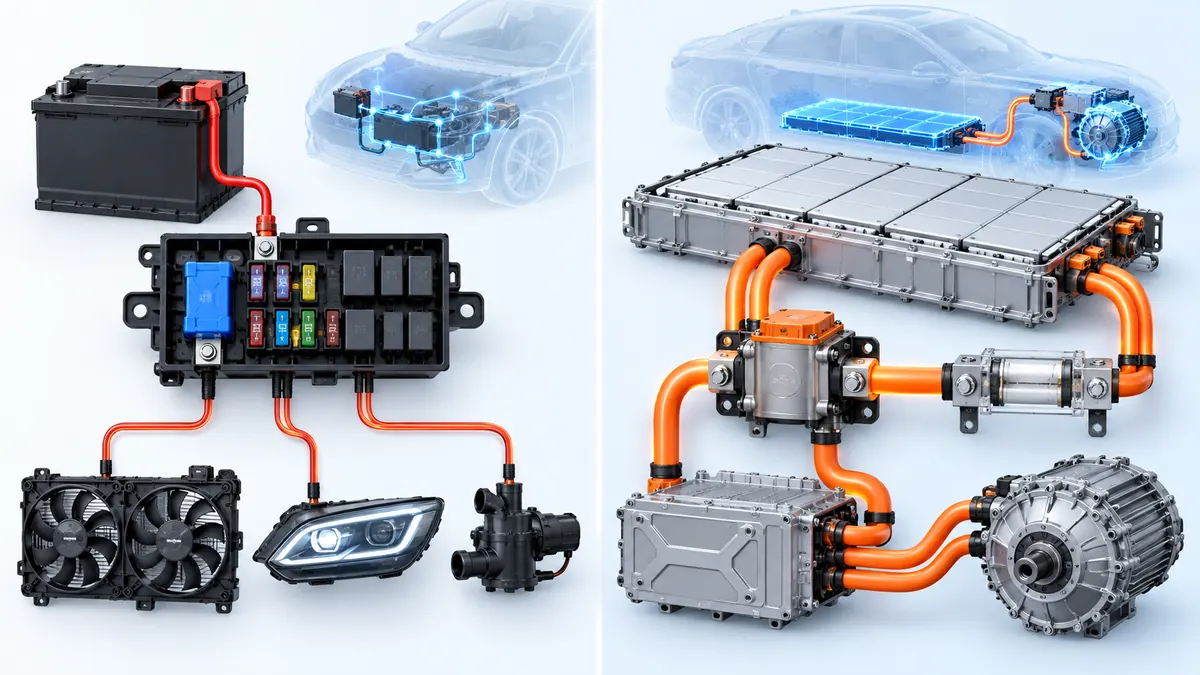
The main difference is the electrical duty each fuse can safely interrupt. JCASE fuses are compact, plug-in automotive cartridge fuses for low-voltage circuits. HVDC fuses are engineered to interrupt high-energy direct-current faults where the arc can persist after the fuse element melts.
| Comparison point | JCASE fuse | Automotive HVDC fuse |
|---|---|---|
| Typical system | 12V, 24V or 48V auxiliary electrical system | EV traction battery, ESS, charger or high-energy DC bus |
| Published voltage examples | Common series are rated 32VDC or 58VDC | Chauron’s published range covers 250–1500VDC |
| Published current examples | 20–60A for common JCASE and low-profile JCASE series | 10–3000A across Chauron’s current product range |
| Breaking-capacity example | 1kA at the stated 32VDC or 58VDC rating for common reference series | Model-specific values from 10kA up to 250kA under stated DC conditions |
| Connection | Female terminals plug into a compatible fuse block or holder | Often bolted or busbar-mounted for controlled high-current connections |
| Response | Often designed with time delay for inrush-heavy auxiliary loads | Time-current behavior is coordinated with cables, batteries and power electronics |
| Typical loads | Cooling fans, pumps, heaters, lighting and low-voltage distribution | Battery packs, BDU/PDU, inverters, OBC, DC/DC converters, PCS and EVSE |
Values in this table are representative examples, not universal ratings. Always confirm the exact datasheet and test conditions for the selected fuse.
What Is a JCASE Fuse?
A JCASE fuse is a compact automotive cartridge fuse with female terminals. It is typically installed in a vehicle power-distribution box or an inline holder. Its relatively low voltage drop and time-delay behavior make it useful for auxiliary loads that draw an initial surge, such as motors, fans and pumps.
For a concrete reference, common JCASE series are published with a 32VDC rating, a 20–60A current range and a 1,000A interrupting rating at 32VDC. Low-profile JCASE series are also available in 58VDC versions. These values illustrate why JCASE devices belong to low-voltage vehicle networks rather than an EV traction battery circuit.
Common JCASE Fuse Applications
- Radiator and condenser fans
- Electric pumps and blower motors
- Heated seats, windows and auxiliary heaters
- Lighting and body-control power distribution
- Low-voltage power outlets and vehicle accessories
A JCASE fuse can still be a relatively high-current device within a 12V or 48V network. “High current,” however, does not mean “high voltage.” The fuse must be evaluated against both quantities and the available fault current.
What Is an Automotive HVDC Fuse?
An automotive HVDC fuse is a one-time overcurrent protection device designed and tested to interrupt faults in a high-voltage direct-current circuit. Because a DC waveform has no natural current zero crossing, the fuse must control the arc created when its element melts. That requires suitable internal spacing, arc-quenching materials, element geometry and validated breaking performance.
Chauron’s high-voltage DC fuse range covers published voltage classes from 250VDC to 1500VDC and rated currents from 10A to 3000A. Each model has its own breaking capacity, time-current behavior, dimensions, mounting requirements and applicable standards.
Common HVDC Fuse Applications
- EV and hybrid traction battery packs
- Battery disconnect units and power distribution units
- Traction inverters and motor controllers
- On-board chargers and high-voltage DC/DC converters
- DC fast-charging equipment
- Battery energy-storage systems and PCS circuits
For lower-current high-voltage auxiliary branches, the compact SEV-10P 500–1000VDC fuse is published for 10–63A. For higher-current 250–500VDC protection, the SEV-30JC EV battery fuse covers a published 100–500A range. Final selection still depends on the full electrical and thermal duty.
Why a JCASE Fuse Cannot Replace an HVDC Fuse
1. The Voltage Rating Is Too Low
A fuse’s voltage rating is the maximum circuit voltage at which it is designed to safely interrupt a fault under its specified conditions. A 32VDC or 58VDC JCASE fuse does not become suitable for a 400V or 800V battery simply because its current rating matches the load. After the element melts, the higher voltage can sustain an arc across a gap that was never designed for that duty.
2. The Required Breaking Capacity Is Different
Traction batteries and energy-storage systems can deliver very high prospective short-circuit currents. The selected fuse must have a breaking capacity above the credible fault level at the relevant voltage and circuit time constant. Chauron’s published automotive and ESS models range from tens of kiloamps to substantially higher model-specific values. This is a different fault-energy class from a typical auxiliary fuse box.
3. Time-Current Coordination Changes
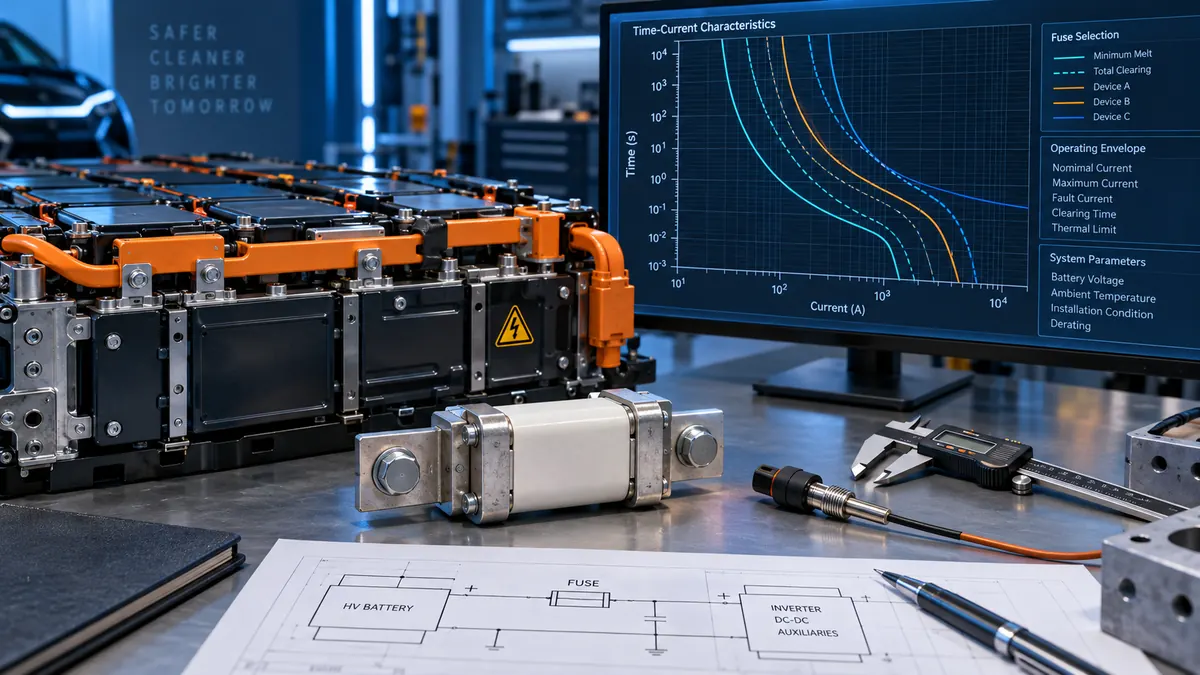
Both fuse families respond to current and heat, but their operating curves are optimized for different systems. A JCASE fuse may intentionally tolerate motor-starting inrush. An HVDC fuse must coordinate with battery cells, cables, busbars, contactors, capacitors and semiconductor devices. Engineers therefore review pre-arcing I²t, total I²t, peak let-through and the complete time-current curve rather than comparing the ampere number alone.
4. Mounting and Thermal Paths Are Not Equivalent
JCASE fuses are plug-in components that depend on compatible female terminals, holders and fuse-box thermal conditions. High-voltage DC fuses are commonly bolted into busbars or dedicated high-voltage holders. Contact resistance, conductor cross-section, cooling, tightening torque, enclosure temperature and vibration all affect performance.
5. Validation Requirements Differ
A fuse must be validated for the intended voltage, current profile, fault current, environmental conditions and applicable vehicle or industrial requirements. Similar shape, equal amperage or an adapter does not establish equivalence. Use the model datasheet and system-level test plan as the basis for design approval.
Can an EV Use Both JCASE and HVDC Fuses?
Yes. Most electric vehicles contain separate low-voltage and high-voltage electrical domains. The 12V or 48V auxiliary network may use JCASE, blade or other automotive fuses for pumps, lighting, controllers and fans. The traction system uses appropriately rated high-voltage protection for the battery, inverter, charger and other HV components.
The two fuse types therefore complement each other at different points in the architecture. Chauron’s EV fuse and pyrofuse solutions focus on the high-voltage protection layer for battery packs, motor controllers, on-board chargers and related circuits.
How to Choose Between a JCASE Fuse and an HVDC Fuse
Start with the circuit voltage and fault duty. The physical package is a secondary consideration. Use the following process before selecting a fuse:
- Identify the electrical domain. Confirm whether the circuit is a 12/24/48V auxiliary circuit or a high-voltage battery/energy system.
- Determine maximum DC voltage. Include normal operating voltage, charge voltage and credible transient conditions.
- Define the current profile. Record continuous current, overloads, pulses, inrush current and duty cycle.
- Calculate prospective fault current. Include source impedance, cable or busbar impedance and circuit inductance.
- Check breaking conditions. Confirm that the fuse’s DC breaking capacity exceeds the calculated fault duty under applicable voltage and L/R conditions.
- Coordinate protective devices. Compare time-current curves, I²t and peak let-through with cables, cells, contactors and power semiconductors.
- Validate installation conditions. Review ambient temperature, cooling, enclosure, terminal design, mounting torque, vibration, packaging space and applicable standards.
For a broader explanation of fuse categories and selection variables, see Chauron’s guide to types of electrical fuses.
JCASE Fuse vs HVDC Fuse Selection Examples
Example 1: 12V Cooling Fan
A radiator fan operating from a 12V auxiliary battery may have a substantial starting surge but remains within a low-voltage automotive circuit. A correctly sized JCASE fuse and approved holder may be appropriate after checking the fan’s inrush curve, wire capacity and available fault current.
Example 2: 48V Auxiliary Power Distribution
A 48V circuit requires a fuse explicitly rated for the system’s maximum DC voltage. A 32V JCASE fuse is unsuitable. A 58V low-profile JCASE device may be considered only when its current, breaking capacity, holder and environmental ratings satisfy the complete circuit requirement.
Example 3: 400V EV Battery Pack
A 400V traction battery requires a fuse designed and tested for high-voltage DC interruption. The engineer must evaluate battery short-circuit current, inductance, continuous and pulse current, contactor coordination and downstream withstand limits. A JCASE fuse is outside this application class.
Example 4: 800V EV Platform
An 800V platform needs an HVDC fuse with sufficient voltage margin and verified breaking performance under the expected fault conditions. Packaging, power loss and I²t become critical because the fuse must carry normal traction current efficiently while protecting expensive battery and inverter components.
JCASE Fuse vs Pyrofuse: Are They the Same?
No. A JCASE fuse is a passive thermal overcurrent device. A pyrofuse is an externally triggered, one-time disconnect that can isolate a battery after a crash or another commanded safety event without waiting for overcurrent heating. Some EV protection architectures coordinate a passive HVDC fuse, contactors and a pyrotechnic disconnect.
Engineers evaluating crash isolation or rapid commanded disconnection can review Chauron’s pyrofuse product range separately from passive HVDC fuse selection.
Frequently Asked Questions
Is a JCASE fuse a high-voltage fuse?
No. “High current” and “high voltage” describe different characteristics. Common JCASE series carry tens of amps but are typically rated only 32VDC or 58VDC. They are intended for low-voltage automotive circuits, not 400V, 800V or higher battery systems.
Can I use a 58V JCASE fuse in a 48V system?
Potentially, but voltage rating alone is insufficient. Confirm the maximum charging and transient voltage, current profile, interrupting rating, conductor size, fuse holder, ambient temperature and manufacturer derating information. The fuse’s rated breaking capacity must also exceed the available fault current.
Can a 60A JCASE fuse replace a 60A HVDC fuse?
No. Matching current ratings do not make the devices equivalent. The HVDC fuse may need to interrupt hundreds of volts and much greater fault energy. Voltage rating, breaking capacity, time-current curve, I²t, mounting and environmental validation must all match the application.
What fuse is used in an EV traction battery?
EV traction batteries normally use a purpose-designed automotive high-voltage DC fuse selected for the pack voltage, continuous and pulse current, prospective fault current, circuit inductance and required coordination. Some architectures also use a pyrofuse and contactors for commanded emergency isolation.
Why is interrupting rating important for a DC fuse?
The interrupting rating identifies the maximum prospective fault current the fuse can safely clear under specified conditions. If the available fault current exceeds that rating, the device may fail to interrupt the arc safely. The rating must be considered together with voltage and circuit inductance.
Does a higher voltage rating make a fuse suitable for every lower-voltage circuit?
Not automatically. A higher voltage rating may satisfy one requirement, but the current range, time-current behavior, power loss, holder, physical size and breaking capacity must also suit the circuit. System coordination determines whether the fuse is appropriate.
What information is needed to select an HVDC fuse?
Provide the application, maximum DC voltage, continuous and overload current, prospective short-circuit current, circuit inductance or L/R, required clearing time, ambient and cooling conditions, cable or busbar details, installation space and applicable standards.
Request an HVDC Fuse Recommendation
If your project involves an EV battery, BDU/PDU, on-board charger, energy-storage system or high-energy DC bus, send the full duty profile rather than only voltage and current. Chauron can review the closest published model and its available technical data. Request high-voltage fuse selection support.